By Peter Popham
A year after the 27-year Tamil insurgency was brought to a decisive end, Peter Popham looks at how China triumphed where the West failed
A year ago, one of the world's most brutal and pitiless terrorist groups, the Liberation Tigers of Tamil Eelam (LTTE), was hunted down and exterminated on a strip of beach in the far north-east of Sri Lanka.
In a war that had dragged on for 27 years, more than 80,000 on both sides had died, hundreds of thousands had lost their homes and the future of one of the most idyllic tropical islands in the world hung in the balance. Suddenly it was all over.
In defiance of all predictions, the war was brought to a swift and bloody end. The plight of tens of thousands of Tamil civilians caught in the middle was brushed aside: a Chinese veto prevented the UN Security Council from even debating the issue, let alone sending monitors to investigate. Foreign journalists were barred both from the conflict zone and the prison camps set up for Tamil survivors, as was David Miliband when the then foreign secretary flew in to try to find out what was going on. Local journalists critical of government action were terrorised into silence.
Then on the morning of 19 May, after a final gun battle lasting an hour, the bodies of 18 of the top Tiger leaders were found sprawled among the mangroves. Among them was the supreme leader, Velupillai Prabhakaran. The war was over.
It was a great victory, the emphatic end of a terrorist gang whom no one in their right mind would mourn. But it was achieved in the teeth of opposition from the US and its allies, and at appalling human and moral cost. How had it been allowed to happen?
The answer, in one word, is "China". When the US ended direct military aid in 2007 over Sri Lanka's deteriorating human rights record, China leapt into the breach, increasing aid to nearly $1bn (£690m) to become the island's biggest donor, giving tens of millions of dollars' worth of sophisticated weapons, and making a free gift of six F7 fighter jets to the Sri Lankan air force. China encouraged its ally Pakistan to sell more arms and to train pilots to fly the new planes. And, crucially, China prevented the UN Security Council from putting Sri Lanka on its agenda.
Suddenly, thanks to China's diplomacy, the hectoring of the US and Europe didn't matter any more. After nearly 500 years under the thumb of the West, the immensely strategic little island in the Indian Ocean had a new sugar daddy – one with a very different conception of its duties. Sri Lanka's "traditional donors" had "receded into a distant corner", the country's Foreign Secretary, Palitha Kohona, told The New York Times in 2008. "Asians don't go around teaching each other how to behave," he said. "There are ways we deal with each other – perhaps a quiet word, but not wagging the finger."
Money, arms and diplomatic cover are necessary preconditions for taking a war to its logical conclusion, but they are not enough. Also required is ideological cover: a casus belli that must go beyond the thirst for revenge, communal hatred or the urge of the majority to impose its will permanently on the minority. It must be possible to sell it as a just war. For this purpose, as Bob Dylan recognised a long time back ("With God on our side"), religion comes in handy.
Enter the Sinhalese Buddhists.
We in the West by and large have a pretty foggy understanding of Buddhism, but one thing we know for certain is that Buddhists are for peace. So the idea that the war party in Sri Lanka – not just in the past five years but throughout the years of independence – was identifiable with Buddhist monks does not sound right. It's like finding Trappist monks engaged in a talk-athon or Orthodox Jews running a pork pie factory.
Buddhists don't do war. Look at the Dalai Lama: for 50 years he has strained every fibre to prevent Tibetan resistance to Chinese oppression turning violent. He has a great line on this challenge: "In the practice of tolerance, one's enemy is the best teacher."
Up close, Sinhalese Buddhism looks as harmless and pacific as any other variety. Visit any temple in the country during Poya or full moon day, a monthly national religious holiday on the island, and you will find scenes of perfect serenity as families dressed all in white offer food to the monks in their saffron robes, then picnic under the trees or stroll around the whitewashed stupa.
By contrast, listen to the words of the Venerable Athuraliye Rathana in 2002: "There are two central concepts of Buddhism," the monk said, "compassion and wisdom. If compassion was a necessary and sufficient condition, then the Buddha would not have elaborated on wisdom or prajna. Hitler could not have been overcome by maitriya [compassion] alone. Today there is a discourse about peace in Sri Lanka. It is an extremely artificial exercise and one that is clearly being orchestrated under threat of terrorist attack."
Imagine those words coming from the mouth of the Dalai Lama and you get an idea of how sharply the views of some Sri Lankan monks diverge from the pacific Buddhist norm. He is not saying "bomb the hell out of the Tigers, as the Allies destroyed Hitler". But the implication is clear enough.
How did Sri Lankan Buddhism veer off so sharply from the other schools? Buddhism was born in northern India in the 6th century BC, and spread throughout the subcontinent and beyond. But eight or nine hundred years later it began to lose ground to new schools of devotional Hinduism, which steadily supplanted it. Eventually it disappeared from the Indian mainland altogether.
Buddhist monks in Sri Lanka watched this process with alarm, and hatched a way to stop it at the coast: they wrote a new book of scripture, the Mahavamsa, to establish indissoluble links between the historical Buddha and their island. The Mahavamsa claimed that the Buddha had visited Sri Lanka three times and had declared it "dhammadipa", "the island of righteousness" – a sort of Buddhist Promised Land, where the Sinhalese should rule and Buddhism should be unchallenged. The Mahavamsa, although not accepted by scholars as a core teaching, helped to ensure that the island remained Buddhism's last remaining outpost in the subcontinent. But there was a price to pay: a vein of intolerant chauvinism, inimical to the religion elsewhere, became part of its permanent baggage.
After independence in 1948, Sri Lanka's Buddhists established themselves as a fierce, intimidating nationalist presence. Although the fourth prime minister, Solomon Bandaranaike, had done the Buddhists' bidding in making Sinhala the official language, he temporised over Buddhists taking over schools run by Christians. So in September 1959, a monk called Talduwe Somarama pulled a revolver out of his robes and shot him dead.
When Mahinda Rajapaksa won the general election of 2004 to become Prime Minister, the Norwegian-negotiated ceasefire of 2002 was already unravelling. One year later, he became President, but even though the island's peace was increasingly fragile, it was still unclear where his policy was headed. His party, the Sri Lanka Freedom Party (founded by Bandaranaike), was, like the opposition, still supposedly committed to the stuttering peace process. The champions of all-out war were limited to 10 newly elected monk MPs and another small extremist party.
Then, in August 2005, the Tigers assassinated Lakshman Kadirgamar, Sri Lanka's highly regarded foreign secretary, himself a Tamil, and peace quite suddenly disappeared from the scene. The following April, the Tigers abruptly cancelled scheduled peace talks in Geneva, and six days later Rajapaksa's new army chief, General Sarath Fonseka, was nearly killed by a Tiger suicide bomb. As the war shadows deepened, monks were again on hand to hurry things along.
On 21 July, the Tigers shut off sluice gates to a reservoir near Trincomalee in the north-east, depriving nearly 30,000 people, many of them recent Sinhalese settlers, of drinking water and water for their fields. A group of politicised monks rushed to a temple near the reservoir and announced that they were going to march on the Tigers' lines and fight them to the death.
It was merely a stunt: as one Sri Lankan journalist who covered the event recalled, "they did not have the numbers or the public support to take on the LTTE during the march. As they were walking they were stopped by the military." But it succeeded in sparking the new war: the air force attacked Tiger positions on 26 July, after which ground troops began the operation to take charge of the gates. The war's final phase was under way.
Like it or not, the pax sinica is spreading across the world: in return for getting the West off Sri Lanka's back, the Chinese got to build a new port at Hambantota on the south coast, a vital link in the "string of pearls" they are constructing across the Indian Ocean, from Burma to Pakistan. But just as significant as the success of the Chinese is the failure of the Western model.
The annihilation of the Tigers took practically everybody by surprise. Sri Lanka had been battling it out against the improvised forces of the Tigers since 1983, but victory never seemed close. Under its charismatic founder and leader, the Tigers fought with fanatical zeal in jungle terrain that was ideal for guerrilla warfare, and the government troops, with their cautious, conventional tactics, were no match for them. Whenever victory seemed on the cards, heavy pressure from India and the West brought the two sides to the negotiating table. A ceasefire signed in 2002 was greeted by the outside world as a major step towards achieving a federal solution. That agreement slowly unravelled, but when the war restarted informally in July 2006, the Tigers still controlled nearly one-third of the island.
By spring last year, the Tigers had lost nearly all their territory and were boxed into 85 square kilometres of jungle – but even then, outright government victory seemed improbable.
Why? Because however brutal their tactics, the Tigers had succeeded in establishing the idea that the Tamils, discriminated against for many years by the Sinhalese majority, were entitled to their own homeland. The conventional wisdom held that this war neither could nor should have a military outcome, but a diplomatic one. Like errant children, both sides would eventually come round: a ceasefire, peace talks, some kind of settlement imposed by pressure from the West and facilitated by the Norwegians was the only way out of the mess, however unsatisfactory. The Tamils would run their side of the island, the Sinhalese would run theirs.
There were plenty of arguments against such a resolution. For one thing, the island's Tamils are by no means confined to the north and the east. Under British rule, Tamils were favoured for government jobs; today Tamils constitute a majority of the population of the capital, Colombo. At the other end of the social scale, tens of thousands of poor Tamil peasants were brought in under the Raj as indentured labour to work on the tea estates. Both Colombo and the estates were well outside the region the Tigers wanted for its sovereign state. But in a small island polarised between warring ethnic groups, and with a history of ethnic cleansing on both sides, what sort of future could Tamils outside "Eelam" look forward to?
But the prospects for Tamils who found themselves inside the state that Prabhakaran wanted to carve out of the island were hardly more promising. During his 25 years in control, the guerrilla leader had been distinguished by one characteristic above all: utter ruthlessness. He had eliminated every possible rival for power, killing all moderate and pacific Tamil leaders as well as those who favoured the gun. He had subjected Tamils both inside the island and in the diaspora to punitive taxes to fund his war, and had forced thousands of families to give up their children to fight as soldiers. He had ordered pogroms against Muslims in the area he controlled, forcing thousands of them to flee, as well as massacring Sinhalese civilians.
Within the ranks of his guerrilla army he demanded total dedication, inventing the suicide bomb as a weapon of war and requiring his cadres to carry cyanide capsules so they could kill themselves rather than submit to enemy interrogation. On the rare occasions he appeared in public, including his one and only press conference in 2002, he always wore military fatigues, cultivating the image of the single-minded guerrilla leader – but family snaps unearthed after his death showed him living in luxury.
His challenge in 2002 was to convince the world that the man who had ordered the assassinations of both the Indian prime minister, Rajiv Gandhi, and the Sri Lankan president, Ranasinghe Premadasa, was capable of re-inventing himself, Sinn Fein-style, as a civilian leader worthy of international respect. But it was a transformation that proved well beyond him: his reflexive response to any crisis remained the same – to murder the people he held responsible. The idea that a man of his kidney could run a plausible democratic state was one of the sicker jokes of the decadent period of US diplomatic hegemony.
But even if Prabhakaran had turned out to possess the political gifts of a Gerry Adams, there is a strong argument to be made that the West had no business trying to dictate peace terms to the legitimate government of the island, faced with an astonishingly brutal insurgency.
The reuniting of Sri Lanka under Sinhalese domination fills many in the minority community with foreboding: a Tamil businessman in Trincomalee told me that he fears the arrival of another wave of government-sponsored Sinhalese colonisation. He also talked of how the new arrivals impose their symbolic presence by installing Buddha statues.
There was plenty wrong with the Sri Lankan polity in the years after independence, and there is plenty still wrong with it today. In the words of the then UN high commissioner for Human Rights, Louise Arbour, now president of the International Crisis Group, after her visit in October 2007, it is a country where "the weakness of the rule of law and prevalence of impunity are alarming". But the idea that these wrongs could be righted by splitting this small island down the middle into two armed camps, and putting one of the halves in the pocket of a homicidal maniac, is one of the crazier ideas to have gained currency in our times.
Sunday, May 23, 2010

Sunday, April 18, 2010
A little day music in Jaffna
By Haasinee Halpe-Andrée
The Chamber Music Society gives a historic first concert in the north, and recognizes a mission to bring classical Western music – Bach and Mozart – to the people of the Wanni

It is early February. We – the Chamber Music Society of Colombo – are in the middle of our weekly rehearsals. Suddenly, the concert master raises his hand to say he has a special announcement. We are taking our music to Jaffna.
The response is a chorus of “Wow!” Three weeks later we – a group of 20 musicians – are on a bus heading to Jaffna. It is March 26, 9 p.m. We have a 12-hour journey before us, and the bus does 60 kph at its fastest.
The younger members of the group are impatient, while the older ones urge all to get some sleep and to try and enjoy the trip. And don’t forget: We are carrying a lot of prized music instruments worth millions. They have to be protected at all costs, especially if this is going to be a long and bumpy and perhaps even dangerous ride. Music instruments are not to be treated lightly.
I tell myself that I will sleep right through the ride and wake up only on arrival in Jaffna. This will not happen. The trip is an adventure, much too exciting and nerve-racking to sleep through.
Settled in for the night, I start to say my prayers before sleep. Jokes about snoring and ear plugs come from my colleagues, while the concert master sits in a corner and snacks on his dinner. One of our main concerns is how many rest-rooms we will get to use on our journey.
Our first stop is a bus stop/tea-shop in Galewala. Our ears are assailed by a Sinhala and Tamil pop version of ‘So This Is Christmas’ enjoyed by the people sitting at a table in front of us. Soundarie and I make a face, then realize we are being snobs, and that music is music, whether it is classical, rock or pop, well performed or not – a universal language and a powerful binding force.
This song could have been doing its bit to support the fragile bonding process between communities. It so happens that the owners of the tea-shop are a Sinhalese, a Tamil and a Muslim. We are a close-knit family, for sure.
We finally arrive in Jaffna, 13 hours later. After staying up the whole night, I was about to drop off to sleep and very nearly missed the famous Jaffna sunrise.
The Wanni
We peer out the windows of the bus. What do we see? Mostly a strange spectacle of devastation and development, side by side. A slow sun rises above a landscape of pale, pocked and pitted, battle-scarred roads.
I recall my last visit to Jaffna, 12 years earlier. The war was raging and we had to wear helmets and bullet-proof jackets. The soldiers had a battle-weary, bleak look in their eyes. This time things are different. Soldiers manning a checkpoint return our waves and greet us with huge smiles as welcoming and beautiful as the now completely visible morning sun.
The bus slows near a water tank that was destroyed during the war. Once-occupied homes are now empty shells. An Army Jeep rattles past us. In the back of the vehicle are covered plastic pails, containing possibly breakfast for a garrison. Yellow ribbons strung up along the road warn us of the lethal presence of land mines yards away.
The bus slows down near a sinister, ugly hulk of metal, battered and misshapen – the remains of the notorious bulldozer-tank that was famously destroyed by the late Corporal Gamini Kularatne, the soldier hero whose action on the night of July 10, 1991 is now a part of history. Six hundred soldiers were surrounded by 5,000 LTTE cadres at an Army camp at Elephant Pass.
An LTTE assault imminent, soldier Kularatne bravely confronted the advancing bulldozer tank and lobbed two grenades into the tank. His action was key to ending the infamous siege on the Elephant Pass camp. Corporal Gamini Kularatne, who at the time was a Lance-Corporal, died of his injuries four days later, and was posthumously promoted to the rank of Corporal and awarded the Parama Veera Vibushanaya, the Sri Lanka Army’s highest award for bravery. Corporal Kularatne is known as the “Hasalaka Hero”, named after the farming village in Kandy where he was born.
Thirteen years ago, in 1997, during an army-escorted media trip to Jaffna, we were taken to see this tank. Today it is a monument to a national hero, decked with garlands.
As our bus proceeds slowly along the uneven roads to Jaffna, we see patches of bright colour – pieces of sari material tied to trees outside kovil prayer stations. There seems a kind of defiance in what should be a welcome touch of colour to the scene.
Cattle on the road make way for us, twitching their ears. Female cyclists go by in vividly coloured frocks and children in white make their way to school. Their school ties hang straight and starched on their uniforms, and they are all barefoot. Not long ago, the Jaffna peninsula was the scene of great suffering and death, and now life goes on, while memories of a 30-year war recede like a bad dream.
It is 7.30 a.m. Jaffna town is wide awake. The streets are a bustling mass of colour as people head to work or to the market.
We get lost in the middle of town looking for our guest house. We stop at a wayside enterprise calling itself ‘Sorry Baby’. The “sorry” bit is puzzling. The proprietor and the waiters should be the opposite of sorry to see a busload of hungry customers at their doorstep. The man making kotthus gives us women a welcoming smile.
Chuckles our soprano, Mary Anne: “Hey, he knows his business!” Smiling soldiers on bicycles stop as we wave to them. We ask whether we could take photographs with them. They oblige readily. “Hondhata gaththaa da?” they ask with broad grins as they cycle away.
Finally we find our guest house and sit down to breakfast. We have steaming-hot pittu, a cream-brown version of the Indian special; the softest of string hoppers, with crab, prawn, cuttlefish, and chicken, and an interesting dish of chickpeas and brinjal, made sweet and sour, accompanied by kotthu and rice. Oh boy! We ordered the same dishes for all our meals that day.
After our late breakfast, we laze on chairs and relax before the concert. Soon it is 3 p.m., with just an hour to go. We clamber back into the bus. In the excitement, I lose a part of one earring, which had been held in place with a piece of chewing gum. The gum was a suggestion from our principal cellist Dushy when my earring came loose on the bus.
We arrive at the concert venue, the cavernous Veerasingam Hall. We all feel very hot in our all-black outfits, black shirts and trousers for the men and concert black for the women. As we walk in, we see a hall that is half full, with mostly schoolchildren. We were hoping for a full hall, but there is still time for last-minute and late arrivals.
It is 4 p.m. Time to begin the music. The orchestra is ready to perform, but the hall is still half full. Well, half-full is better than half-empty, they say!
It is so hot inside the hall that the perspiration is dripping down our faces and backs, soaking our concert kits. We look at the sheets of music in front of us through a mist of perspiration.
We start playing. In the middle of the overture to Handel’s opera ‘Agrippina’, somewhere in the audience a cell phone rings. Then a second cell phone rings. Through the corner of my eye I note that someone is getting up to send someone out of the hall. Close to the stage, from the front row, a foot-tapping audience member is keeping time as oboist Hasitha plays a rhythmic solo.
The applause at the end of the concert is rewarding enough – at least for a half-full hall. The audience crowds round the stage for a close-up look at the musicians and their music instruments. They seem clearly grateful for our presence. They must appreciate the effort to bring one hour’s worth of serious Western classical music all the way from Colombo, a journey that will add up to some 25 hours of travelling time, coming to Jaffna and going back to Colombo.
“Many thanks. Please come again,” they chorus. “Yes, come back again. Soon. We want to hear more of your wonderful music.” “We are sorry the hall wasn’t full, but we’ll make sure it’s packed next time.”
“Yes, you MUST come back. All of you. Please.”
With all the advance publicity for our concert in Jaffna, with notices put in the Tamil and English newspapers, and the generous sponsorship of Concerts Norway, the concert could have had more people. This was a disappointment.
Western classical music has a long way to go up here, just as we had to come a long way to bring Bach, Handel and Mozart to Jaffna. We foresee an uphill struggle to push serious Western music into this world of confused Westernization.
We spend the rest of the afternoon touring Jaffna. Much of what we see is saddening, the results of recent history: we stop to gaze at the magnificent Jaffna Fort, that has taken so many batterings, and the imposing Jaffna Library, next door to the Veerasingam Hall, where we gave our concert.
Jaffna is teeming with visitors and pilgrims from the south and other parts of the country. Many are doing their own cooking out in the open, preparing meals on open fires.
I am confused by the mixed messages I am receiving. Here I am in a great city, and surrounded by gaudy commercial Westernisation. This is not my idea of an ancient city with a rich history woven with strands of Sinhala and South Indian culture.
It is time to head home. We will spend the night in the ancient city of Anuradhapura. It’s been a long day, and we are looking forward to sleeping on the bus over the next few hours.
We are woken up at a checkpoint in Omanthai and asked to get off the bus with our luggage. Five sleepy-looking army staff – two men and three women – apologetically start looking through our luggage.
The boxes and cases carrying our music instruments must intrigue them. It’s unlikely they have seen anything like this before – black containers in a variety of weird shapes and sizes. If this was war-time, these objects would have come under the severest scrutiny.
At Anuradhapura, we get off at our hotel. I share a bedroom with Mary Anne. For the next three hours we talk about the concert and our Jaffna experience. We fall asleep, and when we wake up it is late morning, and we have almost missed breakfast.
Some of us hire bicycles to see Anuradhapura. Lakshman marvels at the ancient city and reminds us of almost three millennia of history and grandeur. Here too, gaudy commercial Westernization stands next to ancient dignified history.
Kesara, our resident photographer, is clicking away. I sit in the shade and sip a Dilmah Moroccan green tea with a cinnamon stick, thinking of Yarl-Paanam, slowly healing and opening up to the rest of the world in her first year of true peace in three decades.
We went all the way there and made music. It was worth it.
Wednesday, April 14, 2010
Sri Lankan Sinhalese And Tamil Community Celebrate Traditional New Year
 Colombo DPA – Sri Lankans are set to celebrate their traditional New Year free of the threat of terrorism for the first time in 26 years, after the army defeated Tamil rebels in May.
Sikhs, Sinhalese, Tamils, and people of South Asian descent across the world celebrated their new year Tuesday. The celebration is known to Sikhs as Vaisakhi, Puthandu to Tamils and Aluth Avurudu to Sinhalese throughout the world.
Traditional sports festivals and other celebrations are among the events planned for April 14, as locals take time off and travel all over the country, including to the northern regions held by the Liberation Tigers of Tamil Eelam (LTTE) until their defeat last year.
The traditional New Year is celebrated by both the majority Sinhalese Buddhists and the minority Tamil Hindus, who account for around 73 per cent and 13 per cent, respectively, of the country's 20-million population.
Sri Lankans are enjoying their new freedom to move around the country, as previously strict security regulations were relaxed. "We are having close to 10,000 visitors to the (northern) Jaffna peninsula from the south of the country," said G Kuganathan, news editor of the Tamil daily Uthayan.
"The majority are Sinhalese who were unable to come here during the war," he added.
During the past 20 years the main road between the south and the Northern Province capital Jaffna was closed, except during a Norwegian-backed truce from 2002 to 2006. Even then, few holiday-makers travelled to the north.
But this year, both civilians who were caught up in the conflict and soldiers are enjoying the most peaceful New-Year season for nearly three decades.
"We have given leave to soldiers - except for the minimum required number - enabling them to visit their parents in their villages," military spokesman Major General Prasad Samarasinghe said.
In the areas worst hit by the fighting last year, soldiers are organizing celebrations for the predominantly Tamil villages, he said.
"We are relaxed and have no tension this year as in other years. Even I can take time to visit my parents," Samarasinghe added.
However, an estimated 75,000 Tamil civilians displaced by the war still remain in camps unable to return home, largely due to the unfinished clearing of landmines, the government claims.
New Year celebrations have also been organized for the displaced persons' camps in the north.
As the checkpoints that used to dot the country's roads are disappearing, Sri Lankans are also travelling to other holiday destinations.
"This year we have seen more people in the market places," Wasantha Chandrapala, a journalist based in the eastern town of Ampara, said. "One reason is that there aren't any security problems and the people can move freely."
Ampara was one of the towns seriously affected by the violence, including several fatal bombs during the war.
Nearly three decades of war cost Sri Lanka the lives of over 100,000 civilians and around 23,000 soldiers. An estimated 7,000 soldiers were maimed and more than 300,000 civilians displaced in the final phase of the conflict.
The ruling United People's Freedom Alliance led by President Mahinda Rajapaksa won a landslide victory with over 60 per cent of the vote in last Thursday's parliamentary elections, largely due to Rajapaksa's popularity for ending the war.
Meanwhile, US Secretary of State Hillary Rodham Clinton also chipped in with her own new year message. In the message released by the US State Department, Clinton said that every year the celebration brings the hope of new beginnings and fresh promise, but this year it carries added resonance.
“For the first time in decades, Sri Lankans from all parts of the island can celebrate together in a peaceful and united country. This is an opportunity for Sri Lankans of all backgrounds, living inside and outside the country, to renew their bonds and work together to build a prosperous, democratic nation defined by tolerance and respect for human rights,” she said.
Uthayakumari, "There’ll be no New Year until I find my daughter"
KILINOCHCHI, 15 April 2010 (IRIN) - Uthayakumari, 39, lost her husband and a son in fighting between Liberation Tigers of Tamil Eelam (LTTE) and government forces in 2009, and is still searching for her daughter who went missing earlier the same year.
The girl was aged 16 when she was forcibly recruited by the Tigers in 2007. Uthayakumari and her family made an ill-fated decision to stay in LTTE-controlled areas to remain in contact with her.

“People in the country are celebrating the New Year this week. For me, every hour that goes by is an hour of suffering and weeping for the death of my loved ones, and trying to locate my lost daughter.
“They [Tamil Tigers] were on a child-abducting spree - they wanted to expand their ranks. My daughter never wanted to join the LTTE. They abducted her in December 2007 from Kilinochchi town and kept her in their camps on the war front. She was a beautiful child who never liked violence, but the LTTE took her away.
“We were helpless. In those days, the LTTE controlled all these areas [in Kilinochchi], so we couldn’t do anything about the abductions.
"We didn’t want to leave the war zone because our daughter was held by the LTTE. I didn’t feel it was right for our family to run away, leaving her. As the war and LTTE moved from Kilinochchi to Mullaitivu areas, we also moved with the LTTE.
"Later on, in April 2009, we decided we had to leave as the war became unbearable. A lot of shelling was going on.
“While we were fleeing Mullaitivu to government-controlled areas, a shell fell between my husband and my son. They both died on the spot; I saw my husband's body being torn into pieces. I was very near to them. My spirit died that day, and I’m now living like a dead person.
“Soon after the last New Year, I lost the people I loved the most. How can I celebrate another New Year? Nothing feels new or fresh to me.
“I have contacted the authorities to find my daughter. I cannot locate her at all. Please help me to find my daughter. Many LTTE-abducted children were rehabilitated and released by the government, but my child was not on any of those lists .
“For me, there will no New Year until I find my daughter. But I just don’t know where to look for her.”
New urban rituals in the traditional Sri Lankan new year
Like much of South India, Sri Lankans also sport colourful unique traditions associated with the annual celebrations of the new year. However the traditions and rituals associated with the festival are different from those practiced in South India and are heavily dependent on auspicious and inauspicious times which are published in all major national newspapers before the date. These include the observance of a nonagatha period (a few hours between the ending of the old year and the start of the new year where you are not supposed to do anything), ganu denu (literally translating to ‘transactions’ – good time to collect lots of money), the traditional lighting of a hearth, etc.
These traditions are held sacrosanct, and a failure to observe them properly is considered highly inauspicious. But like many traditional festivals the world over, some urbanization tends to creep in – mostly by way of shortcuts, a sudden need to accommodate time zones and great confusion on as to how a lot of new fangled technological devices (that are nevertheless an integral part of daily life) fit in. Following is a hilarious yet very true list of urban new year rituals in Sri Lanka.
01. The Kokis Run
(Kokis is a traditional food that is a must have on the table)
Performed approximately 2 days before the new year this ritual involves a trip to the local supermarket to buy kokis, kavum and other avurudhu (new year) foods because the stuff in the shop is better than anything you, your spouse or your maid could ever manage in the kitchen.
02. The Alco Rush
Performed at about 8.30 p.m. in the evening before the wine stores close, this ritual involves individuals standing in long queues to buy unnecessarily large quantities of alcohol because uncle Bebastian (Beba – drunkard) just might drop by.
03. The I-Wish-I-Could-Drop-By Storytelling Session
This ritual involves you making up various excuses not to visit hated relatives and colleagues who feel they are owed a visit by you and/or your family during the avurudhu season.
04. The Can-I-Drop-By Storytelling Session
For individuals who are tired of spending New Year’s day with their family, this ritual allows them to explore the option of spending the day with other -more interesting- individuals (most often those who have completed the Alco Rush ritual).
05. The Perpetual Chain-Sarong
Performed during the ganu-denu (gift giving) time this ritual involves finding a sarong someone gave you last avurudhu and giving it to an individual who will do exactly the same thing with it. It’s just sooo avurudhu to give sarongs.
06. The Time Shift Conversation
Conducted with relatives living abroad. If the auspicious time for boiling milk in Sri Lanka is 7.45 a.m. should your cousin in Little Rock, Arkansas fire it up at 9.15 p.m. on the 13th or at 7.45 a.m. on the 14th? Is he allowed to light a fire in his dorm room anyway?
07. The Microwave Rationalization
This ritual involves an individual attempting to explain to an elderly individual -generally the grandmother- why using the microwave to cook stuff when you’re not supposed to light the fire is perfectly alright. Will result in this incident being referred to when anything goes wrong for anyone in the house for the next 365 days.
A Happy Sinhala and Tamil New Year everyone!
Once Under Attack, Jaffna Media Get Reprieve
By Feizal Samath

JAFFNA, Sri Lanka, Apr 14 , 2010 (IPS) - About eight months back, delivery boys for this northern city’s main newspaper were accompanied on their rounds by government soldiers – the first time a Sri Lankan broadsheet was being delivered under armed guard.
Today, almost a year since the war against the Tamil secessionists ended in May 2009, life for Jaffna journalists is slowly changing for the better.
"We were facing threats from some armed groups and we had to seek protection," recalled M V Kanamylenathan, chief editor of the Tamil-language ‘Uthayan’ newspaper. Ironically, its protector – the army – was also accused – alongside other sectors – of intimidating this newspaper group in the once war-battered northern capital.
"We have gone through hell," said the newspaper’s deputy editor, G Kuganathan. "Things are slightly improving now," he confirmed. These days the military is polite and even apologetic when seeking to publish a press release, he added.
In the past, "they would demand publication [of a press statement] and issue veiled threats if it didn’t appear in the newspapers the next day," Kuganathan told IPS. The military still controls Jaffna, though.
Described as having the most vibrant newspaper industry outside the island capital of Colombo, Jaffna also faced the most serious threat to journalists in this South Asian country, particularly at the height of the 25-year battle against the Liberation Tigers of Tamil Eelam (LTTE).
The ‘Uthayan’ and two other newspapers in the northern city that has an estimated population of 750,000 had faced the worst forms of intimidation and threats to the media. Journalists and media workers were killed and newspaper offices bombed.
During the bloody conflict with the LTTE, journalists across Sri Lanka were under pressure from all sides, including the government and the rebels.
At least 15 journalists and media industry workers across the island state were killed beginning in 2006, when one journalist working for an online newspaper disappeared. Another 15 were either abducted or arrested by police based on trumped-up charges.
Yet no one was arrested despite so-called ‘extensive investigations’ by state agencies.
According to Lakshman Gunesekera, a former newspaper editor, Jaffna’s press suffered tremendous pressure from various forces. "They withstood unbelievable pressure," he said in a phone interview from Colombo.
Pressure on Jaffna’s newspapers, all published in Tamil – the language of the Tamil minority, which is mainly found in northern Sri Lanka – came from government agencies, LTTE militants that controlled the city at different times and Indian peace-keeping forces.
Indian troops came to Sri Lanka in 1987 to help enforce a peace pact between the Sri Lankan government and the rebels. When the pact failed, the foreign force turned their guns on the rebels. Even members of the press were not spared.
"Once a senior Indian officer threatened us with death if we didn’t toe the line," said Kanamylenathan in his modest newspaper office in Jaffna.
The pressure on all fronts was such that at one point, according to N Parameswaram, a Jaffna freelance journalist who works for the Reuters news agency and some Colombo-based newspapers, four militant groups wanted their stories published as lead articles at the same time. "The editor had to tell them that that would be the first time in the world that a newspaper had four lead stories," he said.
Two other Jaffna newspapers, though less popular than the ‘Uthayan’, are ‘Valampuri’ and ‘Thinakural’. ‘Valampuri’ is the mouthpiece of the pro- government Eelam People’s Democratic Front.
‘Thinakkural’ is a Colombo-based newspaper with a Jaffna edition. It toes the line of whoever is in charge in Jaffna unlike the ‘Uthayan’, which voices dissent, albeit with some restraint.
Both newspapers suffered threats and intimidation, though to a lesser extent compared to the ‘Uthayan’.
Gunasekera said newspapers have thrived in Jaffna because, next to Colombo, it is a strong socio-cultural centre. "This northern town has the most educated elite (after Colombo) and high literacy, and many want to write or express their views," he said.
Many of the ‘Uthayan’ journalists left the newspaper following death threats while at least six workers, including two reporters, have been killed since 1985 when the paper started publication. Until tensions eased, the newspaper’s office was bombed at least twice by government jets and Indian peacekeeping forces.
Just before the August 2009 municipal council poll in Jaffna, an unknown group threatened to kill the ‘Uthayan’ workers, including freelance correspondents, if they did not cease publication. The newspaper appealed to the President, who immediately ordered the army to protect the daily.
This led to the unusual situation of armed soldiers on motorbikes accompanying newspaper distributors on their early morning rounds in the city.
"I don’t think anyone has faced the kind of intimidation and threats Jaffna’s journalists have suffered," noted Chulawansa SriLal, convenor of Sri Lanka’s Free Media Movement, the country’s most powerful media watchdog.
On at least two occasions, the ‘Uthayan’ has won bravery awards from a group of local media organisations. These are no doubt well deserved.
Jaffna library trying to put the past behind
By Sutirtho Patranobis, Hindustan Times

Compared to many bombed out homes and churches in town, the Jaffna Library is housed in a starkly and stately, milk-white building.
A statute of goddess Saraswati in the courtyard and armed Sri Lankan army patrols outside the walls keep watch as students, retired government servants and academics step inside the library’s noiseless reading rooms with high ceilings to pour over books and journals.
“You need to take your shoes off (before entering) as this is a ‘temple of knowledge’’, former head librarian S. Thanabaalasinham said.
The library building was inaugurated in 1959 by mayor, Alfred Durayappah, assassinated in 1975 by slain Tiger leader Velupillai Prabhakaran, his first high-profile murder.
But for all the coats of white paint on the façade, the scars of a violent night in 1981 remain like a torn book in the dusty, dark corner of a shelf.
“We can’t replace them,’’ Thanabaalasinham said about the thousands of rare books and Palmyrah leaf manuscripts destroyed when the library was burnt down by a drunk, rampaging mob of policemen on the night of May 31, 1981.
Around 97,000 books and manuscripts were turned to ashes.
The library building was re-built; then, after a second attack, abandoned. It moved to neighbouring Nallur.
For years, the scorched building remained empty with bullet-marked walls wrapped in the lingering smell of burnt pages.
Rebuilding began in 1998 and the new library building was reopened in 2003. It now has more than 100000 books and 200 regular users.
“We are getting books from all over the world. Last month we received 1000,’’ Thanbaalasinham said, adding that library’s website was ready to be inaugurated. He expects that more students and researchers from across Sri Lanka would gradually start using the library.
He spoke about the library’s India connection. The High Commission of India’s first secretary Siddharth Chari laid the foundation stone of the building, targeted in ’81, in 1954.
“After it was burnt down, the Tamil Nadu government with MGR as chief minister sent books worth Rs 5 million to the library,’’ Thanbaalasinham said.

Wednesday, March 31, 2010
Its Election Time Again — Sri Lanka’s Favourite Past Time

By Raisa Wickrematunge
Each election has its own unique properties. This time of course, we have everyone from cricketers to athletes to teledrama actresses contesting. In fact, an unprecedented number of candidates with little or no political experience have decided to jump on the political bandwagon. Perhaps the foray of a retired General into presidential politics was the catalyst for this movement.
In any case, as the country is steadily plastered over with posters and cutouts, let’s take a minute to examine the facts and figures that make up General Election 2010.
7620 Number of candidates who have signed up for the political merry-go-round, according to Additional Commissioner, Elections Department, W. P Sumanasiri. That’s a lot of candidates. In fact, that’s a huge leap, when you compare it to…
5698 The number of candidates who registered to run at the 2004 general elections.
36 The number of political parties contesting this time.
301 Number of independent candidates, as opposed to…
192 Number of independent candidates in the 2004 elections.
127 Number of election-related incidents as of March 25, including assault and misuse of state property (figures by CAFFE)
46 Number of direct elections law violations as at the date above – according to CAFFE.
15 Incidents involving misuse of state property (CAFFE)
100 Number of times Elections Commissioner Dayananda Dissanayake has called for a free and fair election.
11098 Number of polling booths that will be set up around the country so that the people can exercise their basic right to vote.
45957 Total number of IDPs in Jaffna, the Wanni, Batticaloa, Trincomalee and Ampara, to name a few, who are qualified to vote.
416419 Total number of eligible postal voters at this election.
61691 Number of rejected postal votes.
22851 Number of votes rejected because of delays in sending in the application form before the deadline.
43281 Number of postal voters registered in Kurunegala, the highest number in any district.
3000 Number of Duminda Silva posters around Colombo.
06 Number of times main Opposition party UNP has won the general elections since independence
15000 Number of posters featuring a politician carrying a child/hugging the elderly.
There you have it — a laundry list of (mostly) factual figures which make up the general election 2010. Come April 8, it will certainly be interesting to see how many of the 7000 plus candidates make the cut.

Backgrounder: Mathematical complexity in Sri Lanka's parliamentary election
Here is a look at the mathematical wonder of appointing Members of Parliament (MP) based on the proportional representation (PR) system of election in Sri Lanka.
A total of 196 MPs elected from 22 electoral districts would join 29 MPs to be elected based on the national PR to make the total number of MPs in parliament to 225.
Every voter in addition to his vote for the party or independent group of his choice, is entitled to indicate his preference for not more than three candidates nominated by the same political party or independent group. But the preference votes could be cast only if he/she votes for the party/independent group of his choice.
The first step is the determination of the political party/ independent group which has polled the highest number of votes in the particular electoral district or in other words the party or group which won the district. The candidate who is in that party' s list with highest number of preference votes gets elected. This is popularly known as the "Bonus Seat."
Every political party/independent group polling less than 5 percent of the total votes cast in the district is disqualified from having any candidate elected. The votes polled by such parties are deducted from the total votes polled in the district. The balance is known as the "relevant number of votes."
Assuming the final result of the Colombo district would be as shown below;
Number of votes polled in the district 1,200, 000
Votes polled by party A 645, 000
Votes polled by party B 350, 000
Votes polled by party C 150, 000
Votes polled by party D 55, 000
The A party candidate who has secured the highest number of preference votes will get elected as an MP.
The number of votes polled by D would be deducted from the total votes polled. The relevant number of votes for Colombo would then be 1,145,000
The relevant number is then divided by one less than the number of members to be elected from Colombo, i.e.: 19-1 = 18
1,145,000/18 = 63,611
The D gets eliminated as they have polled less than 5 percent.
Thereafter number of votes polled by Party A, B and C is divided by 63,611 as given below;
Party A gets the bonus seat: 1
Party A's total votes 645,000/63,611=10 remainder 8, 890
Party B's total votes 350,000/63,611= 5 remainder 31, 945
Party C's total votes 150,000/63,611= 2 remainder 22, 778
The total number of MPs elected so far would then be 18. Still one more seat remains to be filled up.
The Party B would be entitled to this 19th seat as it has polled the highest remainder.
In case where remainders are level-pegging, the last seat would be decided by drawing lots.
The national list of MPs is created as follows:
After 196 members have been elected, the Commissioner of Elections will apportion the remaining 29 seats among the political parties/independent groups in the same proportion as the votes polled countrywide by each political party/independent group.
For example:
In the last general election the total votes cast was 7,943,706. When it was divided by 29 (seats) the result was 273,920.
Party A polled 3,887,823/273,920=14 seats
Party B polled 3,498,370/273,920=13 seats
Party C and D who polled 143,307 and 132,461 were entitled to the remaining two seats.
Source: Xinhua
Thursday, March 18, 2010
A cow in my lap
 Ravi Velloor is saved by Toyota in Tiger territory.
IN VAVUNIYA, SRI LANKA
THE instructions to me from the Sergeant at the military checkpoint at Omanthai, from where the A9 begins its journey to Jaffna through territory formerly held by the Tamil Tigers, had been friendly but abundantly clear early that morning.
'Your pass is for only a day. That means you have to be out of here by midnight.'
With the ruthlessness displayed by Sri Lanka's military in the final stages of the war fresh in memory, I wasn't about to take any chances with these soldiers. It had taken me four hours from Omanthai to Jaffna through axle-breaking stretches of road where asphalt was a mere memory and the return journey would be at night. Discretion, as they say, is the better part of valour.
So, just after 5pm I reluctantly ended my interviews on the Jaffna peninsula and told Qutubdeen, my driver from the Taj Samudra Hotel in Colombo, that it was time to go. We could easily pass Omanthai before 10pm and, by taking turns at the wheel, expect to be back in Colombo by 2am.
Everything was moving to plan. The day had gone in a rush. Neither of us had eaten, except for some tea and bread at a canteen outside the Jaffna Government Agent's office. But we bought some of Sri Lanka's famous Munchee biscuits, produced by a company owned by my friend Pali Wickremesinghe, thanked Pali for its good taste and sipped water as we moved steadily down, reaching the town of Vavuniya at 7.45pm.
I checked my watch. We were making good time, I thought to myself and at this pace we might get home a little sooner than I initially thought.
Deen and I chatted as we slowed to move through the town and I pointed out to him the Vavuniya police station, scene of a famous Tamil Tiger attack during an earlier time.
Deen steered the Toyota Corolla left at the intersection and I bowed in obeisance as we passed the Ganesha temple on the highway, gathering speed. Two kms down the A9 from that point is a cluster of shops. Some of the lights had gone off, but others were still on. Sitting in the front seat next to Deen, I chatted with him about the Tiger rebels that I had known, now all dead. A vehicle from the other direction would pass us every few minutes; traffic was thin at this time. Although there has been no Tiger attacks since the top leadership was wiped out in May, a sense of unease and foreboding still seemed to fill the land around us.
As Deen dipped and flared his headlamps alternately, I could see animal shapes a kilometre ahead on the other side of the road. From long years of driving in the Subcontinent I know that animals -- and people -- are unpredictable. I raised a cautionary hand and Deen, still focused on the road ahead, sensed my warning and began to slow down.
A hundred metres from the pack and my worst fears came true: the herd, until then serenely standing by the roadside, stampeded. Two dozen animals began a charge across the road. Deen slammed on the brakes and the car screeched to a halt.
With no time to react, we watched some of the bovines veer left and head straight for the car, probably blinded by the headlamps at the same time. One smashed straight into the front right of the car and the next thing I knew there was a cow flying straight at the windscreen, hooves pointed at my chest like some Bruce Lee delivering a knockout karate kick.
I braced for impact, immobilised by the seat belt. Maybe this was the way it was all meant to end after a career spent covering war, famine, riots, assassinations and tsunamis -- killed by a flying cow in Tamil Tiger territory!
The sound of the smashed headlamp was instantly followed by the clutter of hooves on metal as the cow was swept up and landed on the bonnet of the car. The hooves beat a desperate tattoo on the windscreen.
Then, everything went quiet. The animal had clambered off the bonnet, fallen to the ground and picked itself up to stand by the wayside, glowering at the vehicle that had obstructed its run. The windshield had held.
I breathed a prayer.
'Thank you, God. Thank you, Toyota!' I said to myself.
I put out a hand to steady Deen, who gathered himself after a minute and ran out of the car to remonstrate with a man who had followed the cattle out of the shadows.
This fellow reeked of arrack and seemed to have a secret sorrow. He said nothing. This unhappy soul had caused the stampede, apparently deliberately, although he mumbled something about being scared that some animals may be run over by a truck or a bus.
Deen is a Tamil Muslim and the people around us were Sinhalese, so he was careful to keep his anger in check.
It turned out that the man was a former soldier. His age indicated he was too young to retire, so he may either have been a deserter or fired, perhaps. Either way he was in a sullen disposition. We looked at the car.
The right headlamp was smashed. The bonnet was dented and the wipers were bent. The windshield itself was miraculously intact.
Deen called the insurance people in Colombo, who said they would need a police report to process the claim.
Deen looked at me. If I insisted on continuing the journey straightaway he wouldn't be able to claim insurance. I put an arm around him and told him to turn the car toward the Vavuniya police station, which we'd just left behind.
The policemen were helpful. They finished up some work they were doing and turned to our case.
 Right: The writer interviewing President Mahinda Rajapaksa. ST PHOTO: RAVI VELLOOR
The car was examined. A lengthy report was recorded in Sinhalese.
When it was all over, Deen was profoundly apologetic. I told him he had behaved impeccably, both as a driver and a victim.
Toyota has got some bad press lately because of quality issues in the US. But it hasn't affected me. The car I drive in New Delhi, which is my base, is a Toyota -- an Innova minivan. It is a vehicle I love taking out into the country, and especially on monthly visits to my son, who is at a boarding school 300km away in the Himalayan foothills. I love the engine, the way she handles despite her size, the ride comfort. After our little accident -- should I say incident -- at Vavuniya, I am even more of a Toyota fan. Despite the knock it got, Deen's Corolla behaved perfectly, the engine soft as a whisper despite the 200,000km on its clock.
I got into bed at a little before 3am, and slept until 7, too tired to be traumatised by the cow that had nearly jumped into my lap.
Read more blogs from Ravi Velloor on Sri Lanka:
Compassion & violence co-exist
A man who loves his country
The General's wife steps forward
'He was definitely planning a coup'
Monday, March 15, 2010
"I Have Seen Things I Never Thought I Would, So Much Death" - Arulamma Thambiraja
by IRIN, March 1, 2010

Arulamma Thambiraja (above) dreams of celebrating her 100th birthday in her home village
COLOMBO - This time last year, Arulamma Thambiraja, 99, was among tens of thousands of civilians trapped in Sri Lanka's north by fighting between government forces and the since-defeated Liberation Tigers of Tamil Eelam (LTTE).
When the fighting reached her village of Navajeevanam, near the town of Paranthan in Kilinochchi district in January 2009, her family fled deeper into areas controlled by the LTTE. She was carried on a chair by her sons and grandchildren during most of their journey.
In April 2009, she entered a camp for internally displaced people (IDPs) with her family and was there until January this year. She now lives with a relative near the capital Colombo, where she told IRIN of the fighting and her dreams to return home:
"Things were deteriorating by the minute, there was shelling from all sides. I never expected to survive. Every second was like a lifetime there.
"My sons were carrying me. We could not stay in one place for long, it was very difficult. Food was hard to find ... going to the toilet was risking death.
"It is with God's grace that I am here, nothing else. I don't know how I made it out, it was terrible, there were people everywhere running scared. I just closed my eyes every time there was a loud sound; I never expected to open them. It was a like a very long, very bad dream.
"So many things have happened in my lifetime. The war began when I was already a grandmother and in my 60s. I have seen things I never thought I would, so much death, so much destruction.
"When the authorities said we could return to our villages, my family did not want to return immediately. We were not sure what we would find in the village. The house was destroyed, there were mines everywhere. And my children felt I needed rest.
"I don't know anyone in my lifetime who has lived to 100 years, no one in my village has lived that long. I want to be the first, I want go there and celebrate.
"I just want to go back to my village, live like I used to, in peace, with no worries. That is my only dream."
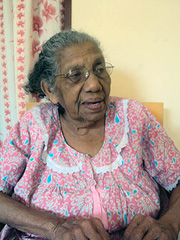
Arulamma Thambiraja (above) dreams of celebrating her 100th birthday in her home village
COLOMBO - This time last year, Arulamma Thambiraja, 99, was among tens of thousands of civilians trapped in Sri Lanka's north by fighting between government forces and the since-defeated Liberation Tigers of Tamil Eelam (LTTE).
When the fighting reached her village of Navajeevanam, near the town of Paranthan in Kilinochchi district in January 2009, her family fled deeper into areas controlled by the LTTE. She was carried on a chair by her sons and grandchildren during most of their journey.
In April 2009, she entered a camp for internally displaced people (IDPs) with her family and was there until January this year. She now lives with a relative near the capital Colombo, where she told IRIN of the fighting and her dreams to return home:
"Things were deteriorating by the minute, there was shelling from all sides. I never expected to survive. Every second was like a lifetime there.
"My sons were carrying me. We could not stay in one place for long, it was very difficult. Food was hard to find ... going to the toilet was risking death.
"It is with God's grace that I am here, nothing else. I don't know how I made it out, it was terrible, there were people everywhere running scared. I just closed my eyes every time there was a loud sound; I never expected to open them. It was a like a very long, very bad dream.
"So many things have happened in my lifetime. The war began when I was already a grandmother and in my 60s. I have seen things I never thought I would, so much death, so much destruction.
"When the authorities said we could return to our villages, my family did not want to return immediately. We were not sure what we would find in the village. The house was destroyed, there were mines everywhere. And my children felt I needed rest.
"I don't know anyone in my lifetime who has lived to 100 years, no one in my village has lived that long. I want to be the first, I want go there and celebrate.
"I just want to go back to my village, live like I used to, in peace, with no worries. That is my only dream."
Thursday, March 11, 2010
Pakistan investigators ‘clueless’ about Sri Lankan cricket team bus attackers one year on
It lasted barely a half hour and yet its impact continues to span a subcontinent almost a year later. On Mar. 3, 2009, 12 militants with guns, grenades, and rocket launchers attacked a bus carrying the Sri Lankan cricket team to a match at Lahore’s Gaddafi Stadium in Pakistan. Six Pakistani policemen escorting the team and two civilians were killed while seven Sri Lankan players and an assistant coach were injured. Various reports blamed different groups: al-Qaeda, local Taliban, Sri Lanka’s LTTE Tamil rebels, and even India’s spy agency. It may never be clear why this happened or what forces were involved.
 Lahore, Mar.4 : It has been more than a year (March 3, 2009) since the audacious terror attack on the visiting Sri Lankan cricket team took place in Lahore and cricket authorities in Pakistan are still struggling to hold any international event in the country, but there has been little progress in the probe to bring the perpetrators of the attack to justice.
As many as eight policemen were killed while seven Sri Lankan players and their assistant coach were injured in the attack carried out by around four to six terrorists near the Gaddafi Stadium.
Pakistani investigation agencies and even Prime Minister Yousuf Raza Gilani blamed foreign hands for the attack, however officials have failed to establish any link supporting that stance.
There has been no follow up into the case leading to the real culprits.
At least four criminals are still at large and it seems that the police has possibly lost the plot in the case.
Describing the attack as ‘horrific’ former captain Ramiz Raja said the country is still suffering from the impact of the tragic incident.
“It was tragic. Pakistan is suffering its impact not only in cricket but also in other sports as we have not been able to host any international sporting event,” The Nation quoted Raja, as saying.
Terming the incident as the cricket’s 9/11, ICC match referee Chris Broad, who was also in the convoy which was attacked near Lahore’s Liberty Chowk, said he would remember the gory incident until he dies.
“The third of the third ‘09 will be with me until I die. It was a horrible day, not only for me but also for the rest of the playing control team over there and the Sri Lankan team. It will be cricket’s 9/11,” Broad said. (ANI)
Sri Lanka: Ambitious Plan To Rebuild Ground Zero In War With Tamil Tigers
By Simon Montlake
Jaffna, Sri Lanka

After 26 years of civil war, Sri Lanka has an ambitious $1 billion plan to revive the city of Jaffna, long isolated by the rebel Tamil Tigers.
In chartered buses and private cars, Sri Lankans pour into this war-ravaged city, finally rejoined to the rest of the country.
Some are ethnic Tamils coming home to see relatives after decades living elsewhere. Others are Sinhalese tourists from the south, curious to see a long-denied corner of their island.
Jaffna served as ground zero in Sri Lanka’s 26-year civil war, which ended last May with the defeat of the separatist Liberation Tigers of Tamil Eelam (LTTE). The city remains run-down, hollowed out by war, occupation, and isolation.
But nine months of peace has opened up road links, pared down the number of military checkpoints, and ended a night-time curfew in Jaffna. Ambitious postwar plans call for the rebuilding of its cratered downtown, though it will take more than money to undo the damage of a bitter, ethnic-based conflict over land and power.
“It will take many, years,” says S K Sitampalam, a retired historian at the University of Jaffna.
 In 1995, the LTTE ceded control of the city and its hinterland to Sri Lankan troops, who carved out giant military bases and used Tamil paramilitaries to police a cowed population. In 2000, the separatist group tried and failed to retake Jaffna but held onto Elephant Pass, a choke point into the peninsula.
For much of the war, Jaffna was a place apart from the rest of Sri Lanka. The LTTE severed road access, forcing goods and people to travel by air or sea. While under government control, it was off limits to outsiders. Residents needed advance permission from authorities to leave.
The tourists are back
Now Jaffna has rejoined the country. Domestic tourism has picked up as Sri Lankans come to gawk at war wreckage and pray at the temples. Jaffna now attracts about 2,000 tourists a day, the mayor recently told a foreign visitor.
Night markets are busy, with hawkers laying out goods on plastic sheets by the road. A long-neglected Buddhist temple is raising money to build a monastery. Many hotels are full, and owners are scrambling to add rooms. The library, rebuilt after being torched by an anti-Tamil mob in 1981, is a draw for visitors. Residents say the dismantling of checkpoints means less tension in their daily commute.
But it’s still uncertain whether the city will emerge as a symbol of post-war renaissance or an icon of festering civil war tensions.
Most of the tourists are Sinhalese, the dominant ethnic group, and they readily accept the official narrative of a liberated city that is earmarked for success under government rule. “There was a war, so we couldn’t come here. It’s developing fast. If we come back after three months, it will be like Kandy,” says Charith Udagedara, a university student, comparing Jaffna to the southern city where he is from.
Sri Lanka plans to spend $1 billion a year to rebuild the north, focusing on the construction and rebuilding of hospitals, schools, government buildings, roads, and electrical grids, according to Central Bank Governor Ajith Nivard Cabraal. The World Bank also recently approved $110 million in loans for projects in the northeast.
Revival is hostage to politics
 The revival of Jaffna hinges, however, like so much else here, on politics. President Mahinda Rajapaksa’s landslide victory left a bitter taste in Jaffna. Voters here largely stayed away from the polls or voted for the challenger, former Army Chief Sarath Fonseka, who has since been arrested on charges of conspiring against the President. Many minority Tamils fear that the government has a Sinhalese agenda that will further marginalise them.
Douglas Devananda, minister of social services and the leader of Jaffna’s largest political party, warns that the President’s poor showing in Jaffna will mean fewer local demands will be met. “If I had got more (votes) in the election, I could have convinced the President to make concessions,” he says in an interview at his office, a converted movie theater packed with armed guards.
For many Tamils, a pressing concern is the resettlement of about 70,000 refugees who were displaced in the final stages of the war and have returned to Jaffna in recent months. Many are still unable to reclaim their houses because they lie inside buffer zones around military installations.
Shriveled population poses another challenge, as it may slow growth and will reduce representation in parliament when the electoral map is redrawn, probably next year.
In 1981, the last year that a census was taken, the city and its eponymous district had nearly 900,000 residents. Its population is roughly half that now, as Tamil residents have fled to countries such as India, Canada, and Britain, or elsewhere in Sri Lanka.
The Tamil diaspora, once an ample source of funding for the LTTE, is unlikely now to contribute to rebuilding Jaffna because it would mean partnering with a government they loathe.
In the recesses of a half-finished house, a Tamil fisherman sits with his family and shows a photo of his son in a school uniform. The man, who gave only his nickname, Pottayah, hasn’t seen his son since the LTTE marched him off to fight.
After escaping the war zone last April, then spending six months in a government camp, Pottayah and his wife and five other children were bussed back to Jaffna. But their home sits inside what is now a military zone. In December, Devananda told families from his village they could return in four months, though the pledge may be less certain after the election.
For now, the family is squatting in an abandoned house made of exposed cinder blocks. Pottayah longs for his life at sea, hauling fish from the rich waters around Jaffna.
“I need to be near the shore to feel that I’m home. It doesn’t smell right here, I can’t smell the sea,” he says.
Sunday, March 7, 2010
Jaffna Road A9: A Highway with a history and promise of a future
Sutirtho Patranobis, Hindustan Times
Both sides of the A9 highway are studded with remains of war. Bombed out houses with bullet marks, scorched trees, bunkers and danger signs in red plastic straps warning 'mines: do not cross'. Along the way, there are many army posts and two checkpoints where vehicles are searched and identities confirmed. As dusk falls, army personnel with rifles slung over their shoulders begin short patrols on the highway.
Outside empty towns herds of abandoned cattle aimlessly roam. These aimless cows are possibly the biggest danger to the hundreds of buses, vans and trucks that now ply the A9 to Jaffna. For decades Jaffna was isolated (except an expensive air link and circuitous sea route) as the highway was closed to civilians. In January, restrictions were lifted.
Till last year, the A9 carried with it the burden of a bloody war; now it’s uneven, potholed surface carries busloads of tourists and trucks full apples and oranges to Jaffna in the north. The distance between Jaffna, at the heart of Sri Lankan Tamil identity, and Kandy, the religious and historical capital of the country’s Buddhist-Sinhalese majority is the 321 km-long highway.
For a better part of the last 27 years, the A9, built by the British in the late 19th century, separated the two entities more than bridging them. Towards the north, the LTTE controlled the highway and swathes of land on either side. Till 2008, the LTTE and the Sri Lankan army (SLA) exchanged bodies of dead combatants at a village called Omanthai on the highway as the International Committee for the Red Cross (ICRC) kept watch.
The SLA and the LTTE fiercely fought to control the road through the 1990s. ``Sometimes the distance would be measured in casualties; like 45 every km. The SLA had launched one its longest operations `Jayasikuru’ (definite victory), in 1997 to gain control of the highway. It was discontinued after heavy casualties,’’ an army officer said. Along the A9 is Kilinochchi, once the LTTE’s administrative capital where chief V Prabhakaran addressed his only press conference in 2002.
In January 2009, the SLA brought the highway under its control in decades.
A year later, northern parts remain war-ravaged. Near Elephant Pass – an expanse of blinding salt fields, the gateway to the Jaffna peninsula – there is a cluster of trees stumps, a literally stark reminder of relentless air-raids by the Sri Lankan air force.
Down the road is a dumped road-roller converted into an armoured vehicle by the LTTE. Now decorated with garlands, tourists from the south pose victoriously in front of it.
There are some signs of life in Kilinochchi. Small shops selling provisions have opened for the displaced who have returned. At the bus-stand, a dozen Tamil displaced wait for buses and their mobile phones to get recharged at a communal phone-charging station. From a nearby kiosk, a Sinhala song is blasting; a change from the all-Tamil signage which remains on crumbling shops.
South of Vavuniya, a Tamil-dominated town which always remained under government control, the vegetation gradually changes, and so does the population. It becomes almost wholly Sinhalese.
Nandikadal revisited
By Hiran Priyankara Jayasinghe in Wellamullivaikkal, Mullaitivu

Around 10,000 motor cycles and 25,000 bicycles belonging to LTTEers and civilians who fled, are seen stacked in the Wellimulliwaikkal and Nandikadal areas and other areas in the Mullaitivu district.
They, together with the innumerable ruined abodes ranging from what were once thatched cottages to well built houses, remain as the legacy of the three decade old war.
 The region bears tell tale marks of the war that was fought fiercely between the LTTE and Government forces. Remains of military vehicles such as bullet proof trucks and jeeps still lie around.
 The Jordanian ship MV Farah 111 that ran aground off the Mullaitivu coast. This ship was used by the LTTE to fire from in a last ditch battle
Herds of cattle are still to be seen reminding us that villages once existed in these areas. The security forces are still in the process of de-mining with the aid of equipment received from a number of countries. Places like Puthukudiyiruppu, Viswamadu, and Putumattalan which were the central areas where the war was fought, are still out of bounds to the public due to the area being infested with mines and permission has to be obtained from the defence authorities to gain access to the area.

A victory memorial has been put up in Puthukudiyiruppu captured by the 53 and 58 Divisions of the Army. Names of all regiments that took part achieving this victory are inscribed on this memorial. A monument to mark the spot where LTTE leader Velupillai Prabhakaran fell is being erected by the security forces.
‘Fonseka Damaged, Politicised The Army’
CURRENT AFFAIRS INTERVIEW
The controversy surrounding the victory of Mahinda Rajapaksa in the Sri Lanka presidential election over combined opposition candidate Sarath Fonseka, refuses to die down. World attention is focussed on the detention of General Fonseka, the former Army Commander and once-wounded war hero who led the action against the LTTE. So far, except for general statements hinting at a coup attempt and a broad conspiracy, the Sri Lankan government has chosen to remain silent about the real reasons behind Fonseka’s confinement and impending trial.
In an exclusive interview, Defence Secretary Gotabhaya Rajapaksa — a former combat officer in the Sri Lankan Army, the real boss of the armed forces and also the President’s equally controversial brother — tried to make a case for the government. He spoke to senior journalist and author INDERJIT BADHWAR:
Under what specific charges did your government arrest General Fonseka?
I cannot talk about specific charges because the summary of evidence preceding the chargesheet is now being prepared by the military authorities under specific rules that guarantee due process and a fair trial. That is the work of the prosecutor.
Because there are no specifics so far, this looks like personal vendetta.
Not at all. Most people are probably unaware of the damage done by the General to our military while he was in uniform, particularly in the way he entered politics.
PHOTO right:Unholy mess Sri Lankan police manhandling a monk protesting the detention of General Fonseka
Should he have stayed out of politics? What is this damage you speak of?
Of course he has that right in a democracy. But he misused his office to pervert the process. Most people tend to simplify this story into three parts — he fought a successful war; he was the army commander; he was arrested because he challenged the president in the election. The real issue is the damage he did by politicising the military. We share a proud tradition with India as the only countries in the region that can boast of a neutral military, but when that tradition was subverted in Sri Lanka by Fonseka, there was no option but to take action against him.
As a war hero, he has many admirers who urged him to contest…He should have made a clean break from the military and then entered politics. In his utter greed for power, he used his position and contacts for his own benefits. He did this while he was Chief of Defense Staff (CDS), and also when he was army commander. He used the commander’s bungalow for political activities and military resources for personal political use.
What kind of political activities? And why the haste in arresting him?
While he was CDS, he was talking to commanders, senior officers. There were complaints of a few soldiers about asking them to work for him. If we did not act on this, we would be signalling that in future others can get away with this. The tradition of a neutral military so precious to us — and India — would have been destroyed.
 Can you be more specific about your phrase “using soldiers”?
Young, lower-level soldiers manning roadblocks were stopping vehicles and seeking votes for the general. Most of them were in a confused state when their own commander contests. In fact, he tried to gather support even among army deserters to whom he gave shelter.
PHOTO: Combative Sri Lanka Defence Secretary dismisses charges of war crimes against his army
He was also using officers and soldiers to conduct surveys and compute vote percentages to measure his support within the army, and this started while he was still the commander. When we found out, we acted against 15 senior officers who were sent into compulsory retirement.
Aren’t there other very serious allegations that the general was planning a coup and assassination of the President and his family?
Well, those are covered under civilian law and are the subject to procedures of criminal investigations, which are a separate procedure. The general’s arrest is in connection with offences he committed while he was in uniform.
Western media and human rights groups are highlighting his arrest and charges of a vendetta.
I’d like to know why they didn’t highlight his public statements during the election when he was openly saying he would arrest the President if he is elected and put him and his ministers in cages.
There were corruption charges against him when he was the army commander — that he was influencing officers to purchase arms from his son-in-law Danuna Tilekeratne’s company Hicorp International. Why didn’t you arrest him then?
Well, the details are only now coming out because there’s been a falling out among the suspects.
Supporters say he is being punished for favouring a quick political solution to the Tamil issue, on war crimes, and the speedy resettlement of the IDPs (internally displaced persons).
I wish more journalists would do their homework. Why don’t you simply analyse his speeches while he was still in uniform, immediately after the war, and those he made when he became a candidate? His first speech to soldiers was that they had not lost their lives and shed their blood only to allow politicians to implement political solutions: ‘We will not allow this’. Is this not an attempt to mobilise the military against the political system?
What about his allegations that you ordered the troops to shoot down LTTE leaders who were surrendering with white flags, in cold blood?
After the war, Fonseka gave a lecture in his old school where he said that the political leadership was trying to protect LTTE interests by asking them to surrender. Now, he reverses his stand, talks about a political solution and says I gave orders to shoot people waving white flags of surrender.
What really happened?
On May 18, 2010 — the day Prabhakaran was killed, 200 LTTE leaders were trapped in an area 400 metres by 400 metres, surrounded by the military. It was past midnight, making it difficult to see them coming out with white flags from the dense jungle. Then some of them counterattacked. Prabhakaran was trying to escape to the lagoon, his son went in another direction. 10,000 surrendered cadres came down from one side. In in the thick of battle, can you expect a young recruit to recognise a senior LTTE leader and take a decision about whether to shoot him or spare him?
The war crimes issue is still alive in the West. What is your opinion?
Yes we recognise what a war crime is — conducting revenge killings, abductions, ransom under the pretext of a military operation. And we have arrested, tried and punished soldiers for this. But there are situations over which we have no control. They claim, for example, that we bombed a hospital. If it is marked as a hospital and we deliberately bomb it, that’s wrong — but we didn’t. Then again, it was the last phase of war. The LTTE were trapped in a small area, where it was difficult to control a stray bullet hitting a hospital. Moreover, in a situation like this there’s no question of patients or civilians in the area.
Why would the western powers want to back a military man?
First, there is a very powerful and moneyed diaspora within LTTE sympathies who play a crucial role in these countries, participates in their vote bank politics and media. Second, because Sri Lanka did not toe the line on certain strategic policies; and third, the human rights lobbies are pushing war crime trials to which they believed the UNP, supporting the general, would be more amenable.
Are the general’s criticisms of your government’s treatment and rehabilitation of IDPS, a source of concern?
As general, he was the only person on our Security Council who opposed the early settlement of the IDPs — the only person. He kept arguing it was a huge security risk. That’s the only reason that the resettlement of IDPs was delayed. When as CDS he had opposed their release. Later on, made common cause with the opposition, which was using the IDP issue to blame the government during the election.
What finally happened?
Newly liberated areas, like Jaffna, the peninsula, and the east were safe and IDPs could be sent back early. Fonseka had a firm “no”. So I said let them at least go to temporary camps in the eastern province. But Fonseca ordered them to be dragged back to the original detention areas. We were under pressure from the UN and other countries but the general kept arguing ‘security’. Finally, the President himself intervened. He said: “What security are you talking about? Here are 300,000 people in these camps; some 20,000 LTTE supporters and cadres have already escaped. So where’s the security? I want them resettled immediately!”
WRITER’S EMAIL
ibadhwar@gmail.com
Post LTTE factor; vigilance the key
It was through Defence Secretary Colonel (Retd.) Gotabhaya Rajapaksa that we got to know that the Government of Eritrea, formerly a part of Ethiopia, a country in the Horn of Africa, had refused to accredit the Charge d' Affaires of the Government of Sri Lanka. The Foreign Ministry has so far made no comment.
It was the Foreign Minister who proposed in August last year that diplomatic relations be opened with the new state. He cited the usual education, trade, economic and political ties between the two countries, but also said that "the exchange of security and intelligence information" is vital to Sri Lanka.
The latter seems to have been the main factor because Eritrea had been considered a trans-shipment point for arms and hub for LTTE activities in the past, and the Government was rightly concerned that it needed a point-man there to monitor these moves.
Hence, though our ambassador in Cairo was to handle diplomatic relations in Eritrea, a senior army officer was to be posted to the station. There was some logic to this, given that it was a military officer in South East Asia who nabbed LTTE kingpin and arms procurement chief Kumaran Pathmanathan alias 'KP'; but whether the officer should have been sent before a diplomat to open the mission is a moot question.
The Defence Secretary blames the entire fiasco on newspaper reports that revealed Sri Lanka's overt intention of keeping a tabs on movements by whatever LTTE fringe elements remain in that part of the world.
One must ask if the normal diplomatic practices were followed. Usually, an agreement is reached between the two countries to establish diplomatic relations. We are told that this was done in Cairo on November 15 last year. The Foreign Minister's cabinet paper to open a diplomatic mission in Eritrea pre-dates this agreement. It is only after such an agreement that the two parties would move for concurrent accreditation. Delegations of senior officials visit each other and then agreement is reached on opening a mission and deciding whom to send. We seem to have put the cart before the horse, and the Foreign Ministry's 'press release diplomacy' about 'finding Eritrean links' etc., clearly unnerved this newly emerging nation.
The LTTE factor is a key issue for the Government, and it is only right that the Defence Ministry keeps a close tab on any developments, but it is important that the Foreign Ministry backs it up with the required expertise on diplomatic protocol.
The Eritrean fiasco must be read with the events that unfolded in London last week, where the Global Tamil Forum (GTF) was held with state patronage.
The Government of Sri Lanka viewed this as an unfriendly act by the British Government. The final declaration of the GTF calls for an economic boycott of Sri Lanka, investigations into 'war crimes' - and self-determination for the Tamils. It is to this type of conference that the British (Labour) Government lent its patronage.
While Sri Lanka's Foreign Minister summoned the British Acting High Commissioner in Colombo and conveyed his Government's dismay, in London our High Commissioner could only meet a Deputy Director of the South Asia desk at the Foreign Office.
It was a terrible comedown for the High Commissioner accredited to the Court of St. James', but then that is the depths to which our foreign relations have plunged. The High Commissioner should not have gone to Whitehall for that meeting. If the Permanent Secretary could not see him, he should have just posted his protest letter.
If that is the kind of hardball the British Government is playing, and we wish to reciprocate, our High Commissioner should have been recalled to Sri Lanka for 'consultations' -- a diplomatic message that conveys unhappiness with bi-lateral relations. We were quick to recall our Ambassador for not being present (he was on leave) when our Prime Minister went to Japan on a private visit, but not for this affront.
Unfortunately, this Government doesn't seem to heed the nuances of protocol, nor realize what a diplomatic snub is, as long as it can play to the gallery in Colombo with street demos demanding that the British go home.
Still worse was that at the meeting, the Deputy Director had pointed out passages of Foreign Secretary David Miliband's speech at the GTF meeting on non-violence, criticising the LTTE for terrorist activity, recruiting child soldiers and not tolerating dissent, -- as if our High Commissioner cannot read English.
Mr. Miliband had also lectured Sri Lanka on human rights. This from one known for duplicity even at home; he recently hired a star Queen's Counsel Jonathan Sumption to suppress evidence of the MI5's (the British External Secret Service) complicity in torturing a terrorist suspect in a case before the British High Court.
One can empathise with the British (Labour) Government battling to survive at the upcoming parliamentary elections and desperate for every British Tamil vote. This arguably, is not the time for it to be considerate towards a fellow Commonwealth member-state and think how it would feel if the Colombo Government supported an extremist Islamic organization that had sympathies with al-Qaeda.
But, enough of British hypocrisy. Where is Sri Lanka's foreign policy heading? Just the other week we lost the GSP+ duty concessions for Sri Lankan exports to Europe despite four Cabinet Ministers making frequent visits to Brussels promising the President that they can turn it around. And, Sri Lanka cannot hope for a change of heart in Britain later this year because even the opposition Conservative Party only recently reprimanded Sri Lanka on the manner it was handling its democracy.
The Defence Secretary has conceded that it is "very difficult" to suppress the residual elements of the LTTE internationally - the 'transnational, transitional Eelam' without the support of the West.
Isn't there then an urgent need to re-evaluate Sri Lanka's foreign policy with the West? The credo of the new world is engagement, not confrontation.
The controversy surrounding the victory of Mahinda Rajapaksa in the Sri Lanka presidential election over combined opposition candidate Sarath Fonseka, refuses to die down. World attention is focussed on the detention of General Fonseka, the former Army Commander and once-wounded war hero who led the action against the LTTE. So far, except for general statements hinting at a coup attempt and a broad conspiracy, the Sri Lankan government has chosen to remain silent about the real reasons behind Fonseka’s confinement and impending trial.
In an exclusive interview, Defence Secretary Gotabhaya Rajapaksa — a former combat officer in the Sri Lankan Army, the real boss of the armed forces and also the President’s equally controversial brother — tried to make a case for the government. He spoke to senior journalist and author INDERJIT BADHWAR:
Under what specific charges did your government arrest General Fonseka?
I cannot talk about specific charges because the summary of evidence preceding the chargesheet is now being prepared by the military authorities under specific rules that guarantee due process and a fair trial. That is the work of the prosecutor.
Because there are no specifics so far, this looks like personal vendetta.
Not at all. Most people are probably unaware of the damage done by the General to our military while he was in uniform, particularly in the way he entered politics.

PHOTO right:Unholy mess Sri Lankan police manhandling a monk protesting the detention of General Fonseka
Should he have stayed out of politics? What is this damage you speak of?
Of course he has that right in a democracy. But he misused his office to pervert the process. Most people tend to simplify this story into three parts — he fought a successful war; he was the army commander; he was arrested because he challenged the president in the election. The real issue is the damage he did by politicising the military. We share a proud tradition with India as the only countries in the region that can boast of a neutral military, but when that tradition was subverted in Sri Lanka by Fonseka, there was no option but to take action against him.
As a war hero, he has many admirers who urged him to contest…He should have made a clean break from the military and then entered politics. In his utter greed for power, he used his position and contacts for his own benefits. He did this while he was Chief of Defense Staff (CDS), and also when he was army commander. He used the commander’s bungalow for political activities and military resources for personal political use.
What kind of political activities? And why the haste in arresting him?
While he was CDS, he was talking to commanders, senior officers. There were complaints of a few soldiers about asking them to work for him. If we did not act on this, we would be signalling that in future others can get away with this. The tradition of a neutral military so precious to us — and India — would have been destroyed.
 Can you be more specific about your phrase “using soldiers”?
Young, lower-level soldiers manning roadblocks were stopping vehicles and seeking votes for the general. Most of them were in a confused state when their own commander contests. In fact, he tried to gather support even among army deserters to whom he gave shelter.
PHOTO: Combative Sri Lanka Defence Secretary dismisses charges of war crimes against his army
He was also using officers and soldiers to conduct surveys and compute vote percentages to measure his support within the army, and this started while he was still the commander. When we found out, we acted against 15 senior officers who were sent into compulsory retirement.
Aren’t there other very serious allegations that the general was planning a coup and assassination of the President and his family?
Well, those are covered under civilian law and are the subject to procedures of criminal investigations, which are a separate procedure. The general’s arrest is in connection with offences he committed while he was in uniform.
Western media and human rights groups are highlighting his arrest and charges of a vendetta.
I’d like to know why they didn’t highlight his public statements during the election when he was openly saying he would arrest the President if he is elected and put him and his ministers in cages.
There were corruption charges against him when he was the army commander — that he was influencing officers to purchase arms from his son-in-law Danuna Tilekeratne’s company Hicorp International. Why didn’t you arrest him then?
Well, the details are only now coming out because there’s been a falling out among the suspects.
Supporters say he is being punished for favouring a quick political solution to the Tamil issue, on war crimes, and the speedy resettlement of the IDPs (internally displaced persons).
I wish more journalists would do their homework. Why don’t you simply analyse his speeches while he was still in uniform, immediately after the war, and those he made when he became a candidate? His first speech to soldiers was that they had not lost their lives and shed their blood only to allow politicians to implement political solutions: ‘We will not allow this’. Is this not an attempt to mobilise the military against the political system?
What about his allegations that you ordered the troops to shoot down LTTE leaders who were surrendering with white flags, in cold blood?
After the war, Fonseka gave a lecture in his old school where he said that the political leadership was trying to protect LTTE interests by asking them to surrender. Now, he reverses his stand, talks about a political solution and says I gave orders to shoot people waving white flags of surrender.
What really happened?
On May 18, 2010 — the day Prabhakaran was killed, 200 LTTE leaders were trapped in an area 400 metres by 400 metres, surrounded by the military. It was past midnight, making it difficult to see them coming out with white flags from the dense jungle. Then some of them counterattacked. Prabhakaran was trying to escape to the lagoon, his son went in another direction. 10,000 surrendered cadres came down from one side. In in the thick of battle, can you expect a young recruit to recognise a senior LTTE leader and take a decision about whether to shoot him or spare him?
The war crimes issue is still alive in the West. What is your opinion?
Yes we recognise what a war crime is — conducting revenge killings, abductions, ransom under the pretext of a military operation. And we have arrested, tried and punished soldiers for this. But there are situations over which we have no control. They claim, for example, that we bombed a hospital. If it is marked as a hospital and we deliberately bomb it, that’s wrong — but we didn’t. Then again, it was the last phase of war. The LTTE were trapped in a small area, where it was difficult to control a stray bullet hitting a hospital. Moreover, in a situation like this there’s no question of patients or civilians in the area.
Why would the western powers want to back a military man?
First, there is a very powerful and moneyed diaspora within LTTE sympathies who play a crucial role in these countries, participates in their vote bank politics and media. Second, because Sri Lanka did not toe the line on certain strategic policies; and third, the human rights lobbies are pushing war crime trials to which they believed the UNP, supporting the general, would be more amenable.
Are the general’s criticisms of your government’s treatment and rehabilitation of IDPS, a source of concern?
As general, he was the only person on our Security Council who opposed the early settlement of the IDPs — the only person. He kept arguing it was a huge security risk. That’s the only reason that the resettlement of IDPs was delayed. When as CDS he had opposed their release. Later on, made common cause with the opposition, which was using the IDP issue to blame the government during the election.
What finally happened?
Newly liberated areas, like Jaffna, the peninsula, and the east were safe and IDPs could be sent back early. Fonseka had a firm “no”. So I said let them at least go to temporary camps in the eastern province. But Fonseca ordered them to be dragged back to the original detention areas. We were under pressure from the UN and other countries but the general kept arguing ‘security’. Finally, the President himself intervened. He said: “What security are you talking about? Here are 300,000 people in these camps; some 20,000 LTTE supporters and cadres have already escaped. So where’s the security? I want them resettled immediately!”
WRITER’S EMAIL
ibadhwar@gmail.com
Post LTTE factor; vigilance the key
It was through Defence Secretary Colonel (Retd.) Gotabhaya Rajapaksa that we got to know that the Government of Eritrea, formerly a part of Ethiopia, a country in the Horn of Africa, had refused to accredit the Charge d' Affaires of the Government of Sri Lanka. The Foreign Ministry has so far made no comment.
It was the Foreign Minister who proposed in August last year that diplomatic relations be opened with the new state. He cited the usual education, trade, economic and political ties between the two countries, but also said that "the exchange of security and intelligence information" is vital to Sri Lanka.
The latter seems to have been the main factor because Eritrea had been considered a trans-shipment point for arms and hub for LTTE activities in the past, and the Government was rightly concerned that it needed a point-man there to monitor these moves.
Hence, though our ambassador in Cairo was to handle diplomatic relations in Eritrea, a senior army officer was to be posted to the station. There was some logic to this, given that it was a military officer in South East Asia who nabbed LTTE kingpin and arms procurement chief Kumaran Pathmanathan alias 'KP'; but whether the officer should have been sent before a diplomat to open the mission is a moot question.
The Defence Secretary blames the entire fiasco on newspaper reports that revealed Sri Lanka's overt intention of keeping a tabs on movements by whatever LTTE fringe elements remain in that part of the world.
One must ask if the normal diplomatic practices were followed. Usually, an agreement is reached between the two countries to establish diplomatic relations. We are told that this was done in Cairo on November 15 last year. The Foreign Minister's cabinet paper to open a diplomatic mission in Eritrea pre-dates this agreement. It is only after such an agreement that the two parties would move for concurrent accreditation. Delegations of senior officials visit each other and then agreement is reached on opening a mission and deciding whom to send. We seem to have put the cart before the horse, and the Foreign Ministry's 'press release diplomacy' about 'finding Eritrean links' etc., clearly unnerved this newly emerging nation.
The LTTE factor is a key issue for the Government, and it is only right that the Defence Ministry keeps a close tab on any developments, but it is important that the Foreign Ministry backs it up with the required expertise on diplomatic protocol.
The Eritrean fiasco must be read with the events that unfolded in London last week, where the Global Tamil Forum (GTF) was held with state patronage.
The Government of Sri Lanka viewed this as an unfriendly act by the British Government. The final declaration of the GTF calls for an economic boycott of Sri Lanka, investigations into 'war crimes' - and self-determination for the Tamils. It is to this type of conference that the British (Labour) Government lent its patronage.
While Sri Lanka's Foreign Minister summoned the British Acting High Commissioner in Colombo and conveyed his Government's dismay, in London our High Commissioner could only meet a Deputy Director of the South Asia desk at the Foreign Office.
It was a terrible comedown for the High Commissioner accredited to the Court of St. James', but then that is the depths to which our foreign relations have plunged. The High Commissioner should not have gone to Whitehall for that meeting. If the Permanent Secretary could not see him, he should have just posted his protest letter.
If that is the kind of hardball the British Government is playing, and we wish to reciprocate, our High Commissioner should have been recalled to Sri Lanka for 'consultations' -- a diplomatic message that conveys unhappiness with bi-lateral relations. We were quick to recall our Ambassador for not being present (he was on leave) when our Prime Minister went to Japan on a private visit, but not for this affront.
Unfortunately, this Government doesn't seem to heed the nuances of protocol, nor realize what a diplomatic snub is, as long as it can play to the gallery in Colombo with street demos demanding that the British go home.
Still worse was that at the meeting, the Deputy Director had pointed out passages of Foreign Secretary David Miliband's speech at the GTF meeting on non-violence, criticising the LTTE for terrorist activity, recruiting child soldiers and not tolerating dissent, -- as if our High Commissioner cannot read English.
Mr. Miliband had also lectured Sri Lanka on human rights. This from one known for duplicity even at home; he recently hired a star Queen's Counsel Jonathan Sumption to suppress evidence of the MI5's (the British External Secret Service) complicity in torturing a terrorist suspect in a case before the British High Court.
One can empathise with the British (Labour) Government battling to survive at the upcoming parliamentary elections and desperate for every British Tamil vote. This arguably, is not the time for it to be considerate towards a fellow Commonwealth member-state and think how it would feel if the Colombo Government supported an extremist Islamic organization that had sympathies with al-Qaeda.
But, enough of British hypocrisy. Where is Sri Lanka's foreign policy heading? Just the other week we lost the GSP+ duty concessions for Sri Lankan exports to Europe despite four Cabinet Ministers making frequent visits to Brussels promising the President that they can turn it around. And, Sri Lanka cannot hope for a change of heart in Britain later this year because even the opposition Conservative Party only recently reprimanded Sri Lanka on the manner it was handling its democracy.
The Defence Secretary has conceded that it is "very difficult" to suppress the residual elements of the LTTE internationally - the 'transnational, transitional Eelam' without the support of the West.
Isn't there then an urgent need to re-evaluate Sri Lanka's foreign policy with the West? The credo of the new world is engagement, not confrontation.
Subscribe to:
Posts (Atom)