Wednesday, October 26, 2011

'I was the best in the world with the offcutter'

The former South Africa fast bowler talks about what you ought to bowl to Tendulkar, digging poetry, nearly losing his eyes, and then some


I wasn't the best athlete. I had to generate pace through muscle and lots of gym work and strong legs. Over 100 metres, I think Ben Johnson would have beaten me by 20 metres.

We used to steal Jonty Rhodes' shirts and swap them for beer:
20 cases of beer or a case of brandy, a case of whiskey and six cases of beer. Every Friday he would go, "Chaps, I have lost another shirt, man. Please help me."

I was a hardworking cricketer. I didn't get it as easy as others. That made me appreciate it more than them.

We lived on a farm in the Free State . My dad was a farmer. My uncle - a big, fit uncle - used to hit tennis balls into the air for us, and we used to take catches. That is my oldest memory of cricket.

I had an action that allowed me to bowl outswing, and the stronger I got, the more the ball swung away.

We didn't really know of apartheid. We were probably very ignorant more than anything else. In our days the clubs had some coloured people - not black guys, because they were playing soccer - but it wasn't guys that ended up playing for the province or the country.

I became a lieutenant in the army at about 23-24. Wonderful. Absolutely brilliant when it comes to discipline. When it comes to knuckling down and focusing. Three o'clock you start waking up, 5 o'clock you are at breakfast, 7 o'clock, when the sun is out, it's half a day gone already. I wish some of our youth can go through some of this to become solid citizens.

I never had cricket heroes. I had rugby heroes. A sportsman like Daley Thompson was my hero. Clive Rice and Graeme Pollock and Garth Le Roux were the three guys I knew of.

The quarter-final in the 1996 World Cup, we got to the ground, had a look at the wicket and said, "Hansie [Cronje], you have got to win the toss. If you lose the toss, the team bowling second, spinners will take all the wickets." We lost the toss, we batted second. We lost eight wickets against their spinners.

There wasn't really that much discrimination at the ground level, but at the top level, where [non-whites] couldn't play for the country.

County cricket taught me how to bowl the offcutter, which is what you should bowl to Tendulkar all the time. I am not talking slower balls - the fast offcutters.

What do the players do nowadays? They don't even look at the public. Morne Morkel and Dale Steyn [the exceptions] are from my clan. South Africans are normally friendly people, but then you have got some of the private-school boys. Our captain is one of them.

I didn't know who Mandela was. The media wasn't allowed to write about apartheid. It was controlled by the government. There was no awareness. When I started studying, at about the age of 19-20, I started finding out about Mandela. So how many fingers can you point? Basically, media controls knowledge.

Everybody gets his own bowling action by accident. That's a fact. To change actions is hard. You can change angles and all.

I was one of the first Afrikaner guys breaking through the system. Corrie van Zyl is one. Allan Donald is one. Many years back some Afrikaners played, but they went to privileged schools. I was a countryside boy. Tough barrier to break down, very tough.

Sydney [1994] was a wonderful start to my career. Beating the No. 1 side on their home soil. Beating them on a spinner's wicket. I took 10 wickets, Shane Warne took 12. Because of offcutters, because of lbws, because of pace variations. It opened the door up for respect, for making a career out of [cricket]. To lose a match and then at the end to win it is what life is all about. We lost 11 of the 13 sessions in that match. Amazing, absolutely amazing.

I couldn't speak English. I learned English at school, but I could only understand and read and write. When I spoke English, I sounded stupid. Language is a terrible barrier. More than one can think.

I have got the jacket for the 1972 tour. The team was selected, but the tour didn't go ahead because of the pressure. For 20 years nobody played. We didn't know what to expect.

I nearly lost my eyes in the army. I was posted in the sports fields. These guys dropped off some lime that they use in building roads, and that lime when it touches water becomes a hard, solid thing, and it becomes heated up. The guys that were working there threw it in a big drum, and it started boiling and cooking and swelled up and blew. I was probably four metres from it. It hit me in the eyes. I was blind for six-seven days. They literally tied me to a bed, held me upside down and threw water into my eyes. For three hours, four hours. It was so sore I couldn't close my eyes, I couldn't open my eyes. It's amazing how you can go through that. Today if I close my eyes I can see a lot of spots because of it. I could have been completely blind. There are eight layers in the eye, and they said six of them were burnt off.

You need to have a wild experience to really enjoy a place, and I think you find that in India.

Allan Donald, he had a lot of pace, and because I was a little bit slower, they tried to play more shots off me, and with the away swing, in the first innings I always got wickets. In the second innings they would start blocking. In 1995 I was the best bowler in the world - No. 1 ranked. Then Allan Donald started taking more wickets, because they started attacking him and started seeing me out. It's amazing how it works if you have got a system where you have got two guys quick enough to take wickets.

I reckon I was the best in the world with that offcutter. Without slowing it down. It went whirrrr. And it worked like a bomb. I took a lot of wickets in England with offcutters. Grassy wicket, bowl offcutters. We had a game here where the West Indian A side had nine left-handers. I took eight of the nine. I could have used that more if we had played a lot of Test cricket in India.

I was absolutely furious with Hansie. I would have punched him. We got paid in our day by winning games. You got extra money by winning games. When we found out that he was involved in singly effecting stuff, I was furious.

The Aussie crowds hate you when you get there. But the moment you start playing well, they come and support you, which I have never seen anywhere else in the world. You need to earn your respect there. The moment I won that Sydney game, I was the best thing since sliced white bread in that country. They can turn around like that, because they are sport-knowledgeable people. That makes a big difference when you are touring there.

I couldn't hear a flippin' note of English when I played in Yorkshire. They sounded pissed every time.

Tony Greig said before the final day [Sydney Test, 1994] that South Africa have got a million-to-one chance of winning. At the post-match interview I told him, "One thing you must remember: South Africans never give up."

I used to vary my pace: 138-139kph was my average pace, but then I bowled the same delivery at 128ks an hour. That is one thing bowlers must learn. I don't see anybody varying his pace by 10ks. They all go 119 or 135. You can vary your pace by 5ks, 8ks an hour. That's when you get the midwicket catches, because the timing is a little bit different.

I would rub the ball in my armpit to make it as heavy as possible. It was not against the rules. The umpires moaned about it, but I said, "Page 40, rule 1". Anyway, spit is worse than armpit.

We were good ambassadors. The chances we took on the field to get the public on our side were calculated. How many times did we have tea time in a Test, and four or three of us stayed on the field and called the boys over the fence and said to the security guys, "F*** you, guys, relax man", and got them on and gave catches to them. And then we would give them our caps. The public loved us for that.

India and Pakistan are the most difficult places to bowl in. If I am a swing bowler, I can come back in the 20th over and still swing the ball. You have got no chance out there.

I studied to become a teacher. I always wanted to be a top rugby player or athlete. Then four players got injured in the provincial cricket team. I came from a third league to play a provincial game. I took six wickets against Western Province, and suddenly I was in the big world of cricket. I didn't even dream of cricket. Just like that, I got there. There was no money then, but that ego was enough for me - the recognition I got at university was enough for me to say, "I want more."

I played in one rebel tour. I played against the Mike Gatting rebels. We played to full houses. Our provincial games, full house. Rebel games, full house. They love sport in this country.

Hansie was the best captain I played under. But you must remember that he had the luxury of eight guys that were captains, and collectively they had 60-70-80 years of experience. A captain is as good as his senior players, knowledge-wise, ability-wise.

I could have become an international javelin thrower. I just hurt my back while throwing. I had a fusion - got big cuts on my back to fuse three vertebrae. Because of that I had stiff hamstrings most of my life. I made it through Test matches and rested enough to be playing the next one. I was one of the lucky ones to do a lot of gym work, a lot of training. That kept me strong.

South Africa aren't chokers. We play more finals than others. You have got to take a look at how many teams have excelled like us.

Our Transvaal teams could have played international cricket. The likes of Graeme Pollock, Garth McKenzie, Corrie van Zyl, Vince van der Bijl, Ali Bacher. They beat the other provinces in two, two and a half days. Bowl you out for 120-150, score 300, bowl you out for 150 again. Game over. Two days. Our sport was strong. There was enough money to coach, to take the game to the next level.

I am a scholar. I have got a library. I am probably a bit more educated in the niceties of the world.

Edgbaston 1999. Is the team a choker or did Klusener make a mistake? It is easy to brand a team. We were cruising. Five balls, one run, the best batsman in the world. Donald knew there was no run, but Klusener was already through. Choking is everybody freezing up and getting bowled out for 40.

I have always been a fan of transformation in players, but never have I liked transformation of coaches. The moment you get guys who are not good enough, and they haven't got the respect of the players, then they might as well be a manager. When it comes to coaching, you pick the best.

When do you start reading poetry? Forty onwards. You don't respect it before 40. Don't have time before that. I am a good six years into the stuff that matters. You don't read silly magazines. It's the next phase of life.

Sidharth Monga is an assistant editor at ESPNcricinfo

© ESPN EMEA Ltd.

Friday, October 21, 2011

An Interview with a Pak speed demon

by Abdul Habib (Please note that this is a file archive interview done on 4th August 2009)
Big names in the world of cricket like Brian Lara, Waqar Younis, Carl Hooper and even Shoaib Akhtar have said that Zahid was the fastest bowler they have have ever seen. Read on to learn more about this tale of what could've been...


Abdul Habib: Tell us about your mentor Nadeem Iqbal.

Mohammad Zahid: He was a very pacey fast bowler who opened the bowling for Multan region with Waqar Younis. Nadeem was faster than Waqar, he was another express pacer. He helped set a first class record by bowling out NBP for just 20 runs, Nadeem himself took 6 wickets for just 9 runs in the process.


Abdul Habib: How did you meet Nadeem and come to be coached by him?

Mohammad Zahid: When I was around 13/14 I was crazy about football and I used to play with my friends at a ground which was shared between games of cricket and football. One day I arrived and there were no football games going on so I picked up a ball and started bowling in one of the cricket games. Nadeem saw me bowling and was very impressed, he approached me and told me that I had natural speed. I wasn't really interested in cricket but Nadeem wouldnt take no for an answer so I joined the Gaggoo Club and started playing cricket. Nadeem taught me everything he knew about cricket, he didnt hold anything back. The amount of knowledge that Nadeem imparted only to me, I doubt Waqar and Wasim will ever give away that much knowledge over the course of their entire lives.


Abdul Habib: Have you seen Nadeem's giant left armer, Mohammad Irfan?

Mohammad Zahid: Yes. I saw him a few years ago, he looked ok then but I havent seen him since.


Abdul Habib: How did you get to play for Pakistan?

Mohammad Zahid: I was living in Saiwal in Multan when the trials for the Pakistan u19 team were happening, Miah Basharat (the President of the Multan Division) sent me to the trials on behalf of Multan region because he was impressed with my speed. There were thousands of boys at the trials hoping to secure a spot in the Pakistan u19 team, to me it seemed like every u19 boy in Pakistan was present for the trials. There were guys like Shahid Nazir, Rana Naved, Shoaib Akhtar, Azhar Mahmood, Mohammad Akram there to try out. I was called into the nets and as soon as Saleem Altaf (the Chief Selector) saw me bowl he selected me straight away. Although my performance hadn't been great, he selected me based on the potential he saw in me. I remember him saying this boy will go far.


Abdul Habib: So where was your first u19 tour for Pakistan?

Mohammad Zahid: I was sent to New Zealand where I bowled really fast, on my return to Pakistan I was signed up by PIA. I played 3 games for them and performed really well, then in the break between the domestic season I was called up to a Pakistan camp. I bowled really fast in the nets and Moin Khan recommended me to Zaheer Abbas, so I got a chance to play for Pakistan.


Abdul Habib: What were your best 3 spells of super rapid fast bowling?

Mohammad Zahid: Back in 1994 (or 1995) I played a one day game for Multan u19s vs NZ u19s at Sahiwal. I had loads of catches dropped but I still took 6 wickets. It was such a thrill to see the New Zealand batsmen backing away from the stumps when I sent down my scorching deliveries. Another one that comes to mind is the game where I took 12 wickets versus NBP, that was another game where catches were dropped off my bowling but I still took lots of wickets The 3rd match was the side game before the test match in New Zealand where I took 11 wickets. I only took around 7 wickets in that side game but I bowled better and faster in that game than I have in actual games. You wouldnt believe the amount of catches dropped off me in that game, if I had to say a number I'd say around a dozen or so. Even though in the Test match I took 11 wickets and was really fast, for me I bowled much better in that side game. (Those 11 wickets were made up of 8 lbws, 1 bowled, 1 caught keeper and 1 caught other)


Abdul Habib: What about your best performance in an International game?

Mohammad Zahid: My debut test match which I've mentioned above and the ODI in Australia where I took Brain Lara's wicket!


Abdul Habib: The game where Brian Lara said you were the fastest bowler he'd ever seen?

Mohammad Zahid: Yes. The game where Carl Hooper and Brian Lara called me the fastest bowler they'd ever seen. For me there hasnt been and there cant be any greater compliment because it came from two batsmen who'd grown up with the great West Indian fast bowlers of yore.


Abdul Habib: Tell us about that match and dismissing Brian Lara.

Mohammad Zahid: The night before the game I had a very high fever, the doctor spent the whole night trying to sweat the fever out of me. I stayed awake wrapped up in several blankets and continuously drinking cups of coffee all night long. I barely got any sleep and the doctor advised me against playing in the game. However Saeed Anwar and Waqar were unavailable for that game and Aamer Sohail had fallen and hurt his head so he couldnt play either. We were virtually down to 10 men and were struggling to field XI players. Wasim Akram called me and told me to get on the coach and come down to the ground to make up the numbers, so I went to the ground. When I got there Wasim took me to one side and said (he'd never spoken to me like this before or since) that to be a big player you have to play though pain and sadness. He said that great players make sacrifices for the team. As soon as he had said that I told him that I was ready to play the game.


Abdul Habib: I wish we had a few more players like that.

Mohammad Zahid: Thank you. In that game Lara was plumb lbw early on but it wasn't given and that made me really angry. My battle had begun, I had to take his wicket. He played a few overs and kept get beaten, then in the over where I took his wicket he was beaten on every ball before I took his wicket. I dont know if Lara was having a bad day or I was having a great day but he really did look clueless against me that day. It was after that match that he said I was the fastest bowler he'd ever seen.


Abdul Habib: You forced yourself into the Pakistan first team and became an automatic selection during an era when you were competing with the likes of Wasim, Waqar, Akhtar, Mo Akram and Ata Ur Rehman. How did that make you feel?

Mohammad Zahid: It's a source of great pride for me and the highlight of my career. It's something no-one can take away from me, the fact that I achieved that through my own blood, sweat and tears. It wasn't easy to get there or to get past so many talented and fast bowlers, I worked really hard to achieve that position in the starting lineup.


Abdul Habib: I did an interview with Mohammad Akram, he said that Waqar and Wasim didn't help young bowlers. He said they saw them as competition and closed them out.

Mohammad Zahid: I agree with him, what he said is the truth. Neither of them went out of their way to help anyone, nor did they give youngsters the help and guidance that they should have.


Abdul Habib: What was your experience with Wasim and Waqar?

Mohammad Zahid: They didn't help me out. They should have been grooming young players and looking to the future of Pakistan cricket but they only looked after themselves.


Abdul Habib: In 1997 Waqar gave an interview saying your bowling style was too demanding, were you aware of that?

Mohammad Zahid: No I didn't know about that at the time and he never said anything like that to me personally.


Abdul Habib: What was it like being part of the C&U Series in 1997 and being part of a Pakistan team that beat both Australia and the Windies in Australia?

Mohammad Zahid: I was very happy to be part of such a strong and successful team, in fact that team may have been one of the strongest in Pakistan's history. I'd never even dreamed of being part of success like that, I was glad my bowling had helped to contribute towards such a huge win for Pakistan against the two strongest teams in the world.


Abdul Habib: What do you feel was your fastest every delivery in any form of cricket?

Mohammad Zahid: It was during a side match in New Zealand before my debut test. That game is burned into my brain, I was just so fast that day. If there had been speed guns present then I'd have broken the world record several times in the same game!


Abdul Habib: What about the yorker to Lee Germon in your debut?

Mohammad Zahid: That was fast but nowhere near my fastest, I remember the yorker quite clearly. My bowling wasnt as fast as I can be in that game.


Abdul Habib: Were you faster than Shoaib Akhtar?

Mohammad Zahid: That's what everyone keep telling me including the wicket keepers and they would know best. Moin has kept to both of us at our fastest and he always says that I was faster than Shoaib. Even Shoaib will tell you the same thing, he's said it to lots of people many times and often mentions it to me when the subject comes up.


Abdul Habib: Are you aware that you have a lot of fans online who are convinced that you were the fastest bowler in the history of cricket?

Mohammad Zahid: No I'm not on the internet so I didn't realise. It's great to hear that I'm still remembered for my speed, please pass on my thanks to everyone for still remembering me.


Abdul Habib: Tell us about when you 'unofficially' clocked 100mph in New Zealand.

Mohammad Zahid: I was touring New Zealand with the Pakistan u19 team back in 1995 and I was still a few months away from turning 19. We played a couple of test matches and some one day games on that tour. During one of the matches (I think it was in Wellington) the venue was fitted with speed guns and I clocked 100mph on them a few times. No other bowler was getting close to that speed and it even made the papers the next day, I still have some newspaper clippings somewhere at home.


Abdul Habib: Who were the other Pakistani bowlers in your team and do you remember what speeds they clocked?

Mohammad Zahid: The other fast bowlers were Rana Naved, Azhar Mahmood and Adnan Naeem. It's over 14 years ago now so I dont remember exactly what speeds they were clocking but it wasnt anywhere close to 100mph, there was a clear difference in the speeds with or without a speed gun. Our coach on that tour was very strict about short pitched bowling, he didn't allow any of the other bowlers to bowl short. I was the only one who was allowed to do so because I was too quick for the batsmen. He told us that Zahid is the only one who can make short balls count so he's the only one who will be allowed to bowl them.


Abdul Habib: What would've happened if there had been speed guns in your day?

Mohammad Zahid: History would've been made many times because I would've kept breaking the 100mph barrier!


Abdul Habib: If you could go back to the start of your career, would you cut your speed to prolong your career?

Mohammad Zahid: If I could go back then I'd still bowl as fast as I could, I've no regrets about bowling fast. Speed was my identity, speed was what I was about. Speed was why everyone knew me and why batsmen feared me. There's no way I would compromise my speed for a longer career because it's better to be who you are than pretend to be someone you're not. Live your life to it's fullest, you may not live as long but at least you'll feel more alive in those few years than you otherwise would if you stretched your career out for decades of mediocrity. The most important thing for me is that when I look back I can truly say that I gave everything I had and so I don't regret any of it. However if I had my time again then there is one thing I'd change, I'd listen to my body rather than other people and I would rest when I was too tired and take better care of myself and my back.


Abdul Habib: What's your advice to youngsters who want to bowl fast?

Mohammad Zahid: The best training is repetition, bowl as many overs as you can in the nets and you will reach your optimum speed. Pace is natural, if you have it then practise will help you hone it.


Abdul Habib: What advice would you give youngsters to help prevent them getting injured?

Mohammad Zahid: I'd give them the advice that I never got when I started playing first class cricket. I wasn't a physically strong person, I had very little muscle on my frame and so my speed wasn't as good as it could've been. Although I was fit enough to run in and bowl at 100mph, the lack of muscle on my frame put too much pressure on body and due to that I became more injury prone. My advice to youngsters would be to stay fit, do lots of bowling in the nets and to keep a regular gym schedule.


Abdul Habib: I take it you're not talking about body building here?

Mohammad Zahid: (laughs) No, certainly not! Fast bowlers shouldn't be going to the gym to do body building. I'm talking about cardio and strengthening the muscles on your back, legs, arms and shoulders in order to prevent those areas becoming injury prone. As a fast bowler you really need to look after your back, that part of your body is crucial to all fast bowlers. But when you're strengthening your muscles you should be careful not to get bulky because that will make you stiff and restrict either your ability to bowl fast or negatively affect your stamina. I never did any of the above and that's the main reason that I got injured.


Abdul Habib: So you're saying that you could've bowled even faster?

Mohammad Zahid: If you've seen me during those days then you will know that I was nothing more than skin and bone, there wasnt a trace of muscle on me. Yet I was still generating the speeds that I did. Now imagine how fast I could've bowled if I'd been physically stronger and been able to bend my back properly when delivering the ball. Don't you think I'd have been even faster?


Abdul Habib: Do you still think that if you really wanted to, you could still bowl the odd one at 100mph?

Mohammad Zahid: It's going to be really tough, those speeds were achieved a long time ago and I'm in a lot of pain these days. However deep inside me, there's this little voice that keeps telling me that I can still do it. Sometimes when I'm bowling, I grit my teeth and really let myself go. On those occasions I'm positive that I'm unleashing some seriously rapid deliveries. Maybe it's not 100mph anymore but probably not that from it either.


Abdul Habib: How fit do you feel these days? Are you still taking pain killers before you bowl?

Mohammad Zahid: Before I go out to bowl I have to tightly strap my ankles, knees, shoulders and back. Pain is my constant companion now, we play each game side by side. It's always there following me around like my shadow but what can I do? I've come to accept that it is a part of my life and I've learnt to play through the pain.


Abdul Habib: How many overs can you bowl in a match now?

Mohammad Zahid: This year I've been bowling 15-20 over per innings so I can still play my role fully.


Abdul Habib: What are your chances of a return to the Pakistan team?

Mohammad Zahid: I did make a comeback in 2003 and despite having been through all those injuries I was still clocking around 90mph then! I made my return to first class cricket with Pakistan Customs after 2 or 3 years away and I feel I've been bowling pretty fast. Of course I would love to play for Pakistan again, who wouldnt? I'd like to have another shot at it before I retire.


Abdul Habib: You just mentioned that you've made a return to first class cricket after 2 or 3 years out, what were the reasons behind you not playing for that period?

Mohammad Zahid: It's not that I fell out of love with cricket but my heart was no longer in it. I kept getting dropped from my domestic team regardless of my performance and when you're getting dropped after performing well it's quite depressing. You can't see any way forward and inconsistent chances sap your morale, so I left cricket because of that.


Abdul Habib: Did you ever bowl to Afridi or Ijaz Ahmed?

Mohammad Zahid: I've bowled to Afridi many times, from the junior level upwards.


Abdul Habib: Afridi loves to dominate the bowling, did you ever have challenges in the nets to see who was more dominant?

Mohammad Zahid: (laughs) No, nothing like that. Afridi would never challenge the fast bowlers in the nets, especially not me. He was always careful around me and didnt mess around, he would even avoid eye contact when the nets were on.


Abdul Habib: But what about when you did come face to face in the nets, did you try and rattle his cage sometimes?

Mohammad Zahid: (laughs) I never got the chance to try. As soon as he saw me, he would call out and say 'lala araam se' (go easy big brother)


Abdul Habib: (laughs) What about Ijaz Ahmed?

Mohammad Zahid: We've played against each other at the domestic level but he didnt ever dominate me like I've seen him do to other bowlers.


Abdul Habib: We've all heard the stories of Inzamam thrashing Waqar and Wasim in the nets, when they were both at their prime. How did Inzi handle Zahid in his prime?

Mohammad Zahid: Inzamam is a different story altogether, he was always too good. I never saw him impressed with what I did, it didnt matter how fast I was bowling to him he just wasn't bothered by it. It didn't matter if I was bowling to him in the nets or in a match, the result was the same. It used to amaze me that even when I was bowling at full tilt and holding nothing back, Inzi would still be playing me quite comfortably. I've never seen another batsman who has so much time when playing the ball.


Abdul Habib: Who was the most difficult international batsman you bowled to?

Mohammad Zahid: In my prime I've bowled to Lara, Taylor, Sachin, the Waughs etc but I didn't feel that I was struggling against any of them. Any time I struggled in a game it was because of my own fitness or rhythm. But when I lost my speed after returning from injuries, I began to feel human. I came to the realization that without my speed I would have to learn other ways with which to take wickets, it wasn't an easy fact to accept.


Abdul Habib: Tell us about your injury. Who was your captain and when did it happen?

Mohammad Zahid: It happened by accident during fielding practise, I was working on diving to stop the ball when I hurt myself and ended up getting whiplash. This was one day before the 2nd test match vs Sri Lanka at Colombo in 1997. Although Wasim was the captain at the time, he was injured for that series and so Rameez Raja took over the captaincy. During the match the injury got a lot worse and I kept going to Rameez to tell him that I couldnt bowl because I was in too much pain. I stressed that it wasn't a good idea for me to keep bowling but Rameez kept re-assuring me that it was probably only a niggle and that I would be fine. Myself and Shahid Nazir were the only two fast bowlers in that match.


Abdul Habib: So you told him that you didn't think you should be bowling?

Mohammad Zahid: It wasn't just me, Saleem Malik kept going up to Rameez and telling him the same thing. Saleem was saying to Rameez that if he didn't stop bowling me then my injury would get worse but Rameez was convinced it was just a niggle and said not to worry and to keep on bowling.


Abdul Habib: Are the flat pitches we prepare in Pakistan the main reason for so many of our fast bowlers getting injured?

Mohammad Zahid: It's one of the reasons, nobody would deny that. But then you have to remember that it's because of those same flat pitches that we produce so many express bowlers. In helpful conditions fast bowlers dont need to go all out like they have to on flat tracks, on flat tracks a bowler has to put everything into his bowling and that's one of the reasons why we have so many speedsters. After my test match debut Imran arranged a meeting with me and taught me about how to get the most out of reverse swing. He said that in order to get extravagant reverse swing you have to give the ball as much air as possible because the moment the ball hits a flat Pakistani pitch it kills the swing and movement. He taught me that the longer the ball stays in the air the more it will swing and the harder it will be to play. The reason I mentioned that was because you asked me about flat Pakistani pitches, the only help a fast bowler gets on those pitches is with reverse swing because those pitches rough up the ball very quickly. In order to make the most of reverse swing you need to be able to generate express pace and thats why our pitches produce so many express bowlers. Because our bowlers cant get away with bowling within themselves and letting the conditions do the rest. Our bowlers have to put all their energy into each delivery. Coming back to your question about the causes for injuries, I would say a lack of proper education about fitness is a bigger reason for injuries than flat pitches.


Abdul Habib: So getting back to your injury, where did you get it treated?

Mohammad Zahid: It was treated in Nottingham, England. I'd signed to play county cricket with Nottinghamshire and arrived in the UK carrying my injury from the test series. It wasn't until I reached the UK that I was diagnosed with stress fractures to my back. Nottinghamshire were very good about it and the took care of the costs and the treatment straight away.


Abdul Habib: But you suffered the stress fractures whilst on national duty, wasn't it the PCB's responsibility to take care of the costs and the treatment?

Mohammad Zahid: Majid Khan was the head of the PCB at the time and he told me that they wouldn't pay for me to get it treated straight away. They wanted me to return to Pakistan where I'd be checked out by PCB's own doctors and then a decision would be made on whether or not they would pay for the treatment. The county on the other hand were offering to pay for me to be treated straight away because they knew injuries of this nature need to be dealt with fast.


Abdul Habib: That was very nice of them, I guess their insurance must've covered it.

Mohammad Zahid: I don't know, maybe it did. I accepted the county's offer because it was better than catching a long haul flight back to Pakistan, waiting around to be tested and then waiting for the results. The PCB's actions didn't make any sense to me, by travelling I would risk aggravating my injury and even if the PCB agreed to pay for the treatment they might just end up sending me back to the UK to have it done. Then doubts began creeping into my mind, what if the PCB did the tests and decided they wouldnt pay for my treatment? I would've turned down Nottinghamshire's offer and be left with serious stress fractures but no help from the PCB either. So that's why I accepted Nottinghamshire's offer and I'm very thankful to them for all that they did for me when I needed their help.


Abdul Habib: That's disgraceful from the PCB, especially considering the way they've showered money on Shoaib over the years.

Mohammad Zahid: They did help Shoaib and they were right to do so but at the same time they should've done the same for me and others in my position as well.


Abdul Habib: In 2003/2004 Mohammad Sami was constantly clocking 95mph+ but he never converted his speed into performance, what went wrong with him?

Mohammad Zahid: Sami was a genuine express pacer, he had the sort of speed which could've seriously troubled batsmen. However he couldnt work the pitch, there was no help for him off the deck. After pitching his deliveries used to come in dead straight and because he wasn't tall he didn't get even get extra bounce off the pitch. During Waqar's last few years (when he was captain) he used to take Sami around with him, Waqar put an awful lot of work into Sami at that time. He tried very hard to make him into a successful bowler but it didn't work. Waqar used to tell Sami that his wrist breaks away when releasing the ball and that Sami needed to keep his wrist upright till after he'd released the ball. Waqar said that this problem took the bite out of Sami's bowling but Sami couldnt keep his wrist upright.


Abdul Habib: What's your opinion on Sohail Khan.

Mohammad Zahid: He quick but he's not express pace, he will have to put a lot of effort into his bowling if he wants to make it at international level.


Abdul Habib: If you were his coach what would you advise him?

Mohammad Zahid: He's too bulky, too stiff. If he wants to make the most of his speed then he needs to get leaner and work on his fitness. His arm needs to be straighter, it comes to the side a bit and that's not good. If Sohail was express pace then wherever he landed the ball he would trouble the batsman but he isn't so he needs to learn variation if he wants to be successful.


Abdul Habib: What about Mohammad Talha?

Mohammad Zahid: He's impressive, I'd say he's better than Sohail. Talha needs to work on his run-up and his fitness levels. He's very skinny like I was at his age and he needs to bulk up a bit to give his upper body more support. Talha's quick but not impressively so and he's already suffering from back problems. He had to change his action because his previous action was dangerous and putting him in too much pain. There's a lot of hard work in Talha's future and most of all he has to be very careful with his body to avoid unnecessary injuries.


Abdul Habib: Have you seem Mohammad Aamer?

Mohammad Zahid: Yes I've seen him and he's very good but he's barely 18, too young at the moment.


Abdul Habib: Weren't you around 18 when you debuted?

Mohammad Zahid: (laughs) Yes, you're right! I was around the same age. I played a game against him earlier this year and I think he was carrying an injury. He's a good bowler but he needs time to learn.


Abdul Habib: Do we have any super quick bowlers lurking in domestic cricket waiting to take us all by surprise?

Mohammad Zahid: No, we dont. To be completely honest with you I havent even seen anyone on the domestic scene whom I'd call consistently fast let alone approaching express pace. It saddens me to think that just 10 years ago each domestic team had at least one bowler who was consistently clocking over 90mph. In those days it wasnt a big deal for a Pakistani bowler to clock 90mph nobody would get excited by it. But these days if we see a player clock 140k then 'poore Pakistan mai shor mach jaata hai' (the whole of Pakistan starts shouting his name).


Abdul Habib: (laughs) That's so true!!

Mohammad Zahid: In those days we had so many 90mph bowlers like Aamer Nazir, Mohammad Akram, Shahid Nazir, Rana Naved, Shoaib, myself, etc. Back then no-one would pay any attention to a Pakistani bowler clocking 90mph but these days when Sohail Khan goes over 145kph it's literally a street party. Please don't take my statements as a criticism of bowlers like Sohail and Talha because they are our future and we must back them all the way. All I'm doing is putting their speeds into perspective with what we had 10 years ago.


Abdul Habib: I totally agree with you, also Mohammad Akram said the same thing you've just said.

Mohammad Zahid: Well Akram should know because he broke into a very strong Pakistan bowling lineup himself and was a very fast bowler in his own right. He was much faster than anyone coming through these days.


Abdul Habib: What are your best memories from your career?

Mohammad Zahid: The fact that I played for Pakistan and performed. I used to play cricket for fun, I'd never thought I'd play a test match for Pakistan so just playing was a highlight for me. Also I can never forget my debut test vs New Zealand.


Abdul Habib: What do you Pakistani express pacers have against New Zealand?

Mohammad Zahid: What do you mean?


Abdul Habib: You all totally wreck New Zealand early on in your careers.

Mohammad Zahid: (laughs) Koi Zaati Dushmani Nahi Hai (there's no personal enmity at work), I guess their batsmen just struggle to play express pace.


Abdul Habib: What's your worst memory?

Mohammad Zahid: Getting injured and all the problems that resulted from it.


Abdul Habib: What are the best compliments you've received?

Mohammad Zahid: Brian Lara and Carl Hooper calling me the fastest bowler they'd ever seen, that'll stay with me. Once when I met Geoff Boycott and he pulled my shirt up to look at my back and he asked how on Earth I could generate pace like that from such a skinny and weak body (laughs). I remember compliments from Richie Benaud, the Chappells and many other commentators about my speed and bowling in those days. It was a great time for me, so many compliments and so many people praising me.


Abdul Habib: Were you ever approached by the ICL?

Mohammad Zahid: No, I havent been playing cricket for the last few years. I only started again this season.


Abdul Habib: What lies in the future of Mohammad Zahid? A coach, a commentator or something else?

Mohammad Zahid: I love coaching, it's a passion of mine. I have a level 2 coaching qualification from England and I will be going for the level 3 qualification as well. I want to work in the real Pakistan with those kids from small villages that want to play for Pakistan from their heart. The sort of people who would cut off their leg just to get a chance to play for Pakistan. It's my dream to help these sorts of kids who dont stand a chance of playing without people taking an interest in them.


Abdul Habib: It's been a pleasure talking to you and best of luck for the future

Mohammad Zahid: Thank you and my salams to all my fans, thank you for remembering me.
Thursday, October 13, 2011

Indian fast-bowling clinic sued for gross incompetence

R Rajkumar

Bowlers blame academy for loss of pace, hair and sex appeal

Jurors deliberated late into the night in Chennai yesterday as they tried to come to a decision on whether or not to penalise coaches at the MRF Pace Academy for alleged malpractice and gross incompetence.

A number of prematurely aged current players and ex-India internationals, all of them medium-pace trundlers in their mid-thirties and forties, have sued several officials, including head coach Dennis Lillee, for malpractice regarding compromised bowling actions and speed levels they say would never have befallen them had they been informed of the risks before joining the clinic.

"Yes, you may not get the hair gel ads where they surround you with beautiful women, but there'll always be Advanced Hair Studios"

According to prosecutors in the case, pace-bowling trainers at the clinic went about taking promising young bowlers with raw pace and "sucking the passion out of their bowling like living marrow from a healthy bone".

As a result of the training received at the clinic, the bowlers allege that, ironically, they suffered a marked decrease in pace, and one of them (Venkatesh Prasad, who understandably wished not to be named in this article) had in fact emerged from the experience a legspinner.

Aside from the main criminal complaint, the bowlers are also suing the clinic for associated collateral damages, including loss of sex appeal, loss of potential increased revenue from advertising had they indeed become fast bowlers of some repute and thereby possessed said sex appeal, a lack of success at being able to "score" with the opposite sex, an inability to justify growing long hair, and, perhaps the worst charge of all - for having irrevocably developed safe, predictable personalities only too happy to sacrifice risk in favour of leading lives of quiet, military-medium desperation.

Speaking on condition of anonymity, another product and former patient of the clinic, Munaf Patel, said he regretted the day he made the decision to join the coaching centre. "Before going there, I had pace, I had swing. I could see fear in the batsman's eyes. Could smell it, even. I mean, just look at some of my old videos on Youtube. It's like I'm a different person. Hell, even I had long hair back then. Look at me now. I bowl wicket to wicket as per what was taught to me, and have all the aggression and vitality of a half-hearted fart that's been locked in an airtight room without sunlight for two weeks straight. Don't even get me started on what's happened to my hair."

Meanwhile the Indian government said it will be appointing a team to look into claims that the so-called pace foundation was in fact a top-secret Australian project to undermine Indian fast-bowling talent. According to reports, the government was faced with a tricky chicken-or-egg scenario, whereby it needed to determine which came first, the academy or the lack of fast-bowling talent in the country, before it could formulate the next step in the investigation.

Chennai's police commissioner JK Tripathy told the court that when his officers broke into Mr Lillee's office to take him into custody, the legend leaned back in his chair, smiled, lit a cigar and said, "Well, looks like the gig is finally up, boys. No use fighting it, you may as well take me in. I've had a good run. Took you long enough to catch on, though, didn't it?"

Assistant coach TA Sekar, who now works with the ironically named Delhi Daredevils, refused to apologise to the velocity-challenged victims, let alone admit to having done anything wrong. "We did what we thought was best," he explained to the court. "When we saw a bowler with promise and raw pace, we immediately told him to adhere to the time-honoured tradition, here in India, of line and length. This was because at the academy we like to think that we build not just strong pace bowlers but strong characters. And there is a lot to be learned from line and length: values such as restraint, mind-numbing perseverance when faced with a distinct lack of success, and, my personal favourite, love."

At this point the court was disrupted when someone in the crowd pushed forward and tried to throw a pie at Mr Lillee. It later turned out the assailant was none other than once-potential Indian fast bowling legend Atul Wassan. Mr Wassan was thwarted in his attempt at getting at his victim by defence attorney Ram Jethmalani, who heroically belied his age by reaching across his client and deflecting the thrown pie. After the commotion subsided, and Mr Wassan was being led away by bailiffs, Lillee could be seen magnanimously appealing to the judge: "Please, let him go. He's just practising what we've taught him."

The case continues.

R Rajkumar hopes that writing about cricket helps justify his watching it as much as he does to the people in his life who wonder where the remote control's disappeared to.

All quotes and "facts" in this article are made up, but you knew that already, didn't you?

Monday, June 13, 2011

Were Sri Lankans the earliest tourists of the world?

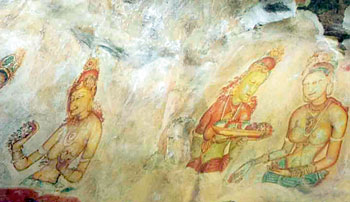
The maidens that adorn the Sigiriya rock have inspired many an ancient traveller to write verses on the famed Mirror Wall

The world-famous Mirror Wall at Sigiriya reveals thriving tourism from ancient days

By Rajitha Weerakoon

Domestic-tourism may not figure as an important component in today’s tourist roadmap. But graffiti scribbled on the Mirror Wall (Kaetapat pavura/kaetabita) at Sigiriya reveal that there had been quite a load of Lankan tourists travelling from as early as the sixth century AD, long before tourism saw the light of day in the West.

During a discussion on Sigiriya when Dr. Raja De Silva, Retired Commissioner of Archaeology forwarded his theory that Sigiriya was a Mahayana monastery and the frescoes were paintings of Goddess Tara, Dr. Roland de Silva, Retired Director-General of the Central Cultural Fund raised the question “Was Sigiriya the earliest tourist-site in Asia?” in which case Sri Lankans would be the earliest Asian tourists? He was quoting from Sigiriya graffiti deciphered and translated into English from the eighth to the tenth centuries AD by Professor Senarath Paranavitana.


The maidens that adorn the Sigiriya rock have inspired many an ancient traveller to write verses on the famed Mirror Wall
But Sigiriya, whether this isolated rock monument was King Kassapa’s (477- 495AD) abode, a representation of God Kuvera’s Alakamandawa or a Mahayana Temple, was an architectural marvel with exquisite decorative work, sculpture, well-planned landscapes, ponds, fountains and a tantalizing art gallery which drew Sri Lankans to the site from many parts of the island.

The spontaneous outbursts left behind in the form of free verses by these random visitors on the Mirror Wall give evidence of the fascination Sigiriya had held for them whose visits extended from the 5th to the 13th centuries with more active visitations being made from the 8th to the 10th centuries. Verses ceased appearing in the 13th century with the jungle tide taking over Sigiriya coinciding with the shift of the capital from the North Central Province (NCP).

Whereas in Europe, Dr. de Silva said tourism was “leisure education” in Greece and Italy for scholars and cultured tourists of colonial Europe and according to the Oxford English Dictionary “tourism was born in the 17th century and the Englishmen were the first to practise it.”

Over thousand years prior to this, it was a cultured lot who made the trek to Sigiriya as well. But what made the Lankan tourists unique was that they left behind verses which expressed their individual views on their visits and their feelings of what they saw in beautiful stanzas on the shimmering Mirror Wall while giving us an indication of the literacy-level that prevailed in the first Millenium.

“(Hail!) the resplendent rock named Sihigiri captivates the minds of those who have seen (it) as if (the mountain) Mundalind, which was adorned by the King of Sages (i.e. the Buddha) has descended on the earth.” (verse 82)

And, “We saw at Sihigiri, the King of Lions whose fame and splendour remain spread in the whole world.” The pride they felt had spilt over to the verses.(verse 37)

About tourist-arrivals they wrote thus: At the present time, hundreds of thousands of householders remain clinging to this. (They) look at this a hundred thousand times in order to impress in their memory what there is at Sihigiri. (verse 130)

The legend of Sigiriya itself may have set the tone as a tourist attraction with its theatrical backdrop of “palace coups,” “court drama” and the predicament of a great King. But what we find is that most of the tourists had become captives of the Sigiri damsels as thousands of verses written in their dedication illustrate.

“Svasti! (Hail!) I am Agboy. I wrote this. Like a vatkol flower entangled in a blue katrol flower, the golden coloured one who stood together with the lily coloured one will be remembered at the advent of the evening!” (Verse 334)

Not only romance but sensual feelings had been expressed in abundance by these early tourists. “Prosperity! When (I) saw the lonely woman, my mind inclined itself (to her and she) took (to herself) my eye. If (you) having seen, have not accepted me (as your lover,) heart was never aflame in former days…”(verse 51)

There had been complaints made too by disappointed lovers: Ah! This (manner of) standing of yours o deer-eyed damsel, is indeed (that) of not having known the (very) name of intimacy…..pleasure has been received by others. When you are come (you say that there is) no intimacy (in me.)”(verse 31)
For those who were curious to know the numbers of damsels that adorned the Sigiriya wall, graffiti written in an earlier period provides the answer. “ ……..five hundred damsels who ( in their) splendour are (like unity) the crest jewels of the King.” (verse 61)

Professor Nimal De Silva, Chairman of the UDA at the time the discussion was held offering his views on the damsels said that the western façade of the rock of 30 by 100 metres plastered and painted was once one canvas and may have looked like a “cheettha redde” (floral-printed chintz) with female figures scattered all over. This delightful mural indeed would have been a feast to the eye of the earliest tourists before it was subjected to the ravages of nature.

But what evidently fascinated the tourists was the mystery that surrounded these voluptuous ladies. “…..the deer-eyed ones do not speak, (remaining) in the self-same manner in which they have severally been painted. I am prince (Apa) Bamdi Dapul” (verse 74)

And of their identity, even those who scribbled verses just a century later from the historically accepted time of Sigiriya origin of the fifth century seemed to have been ignorant of it. Why was their identity shrouded in mystery?

In the relatively recent past, H.C.P. Bell identified the damsels as ladies of Kassyapa’s court going towards the shrine of Pidurangala. Paranavitana suggested that they represent lightning princesses and cloud damsels. Dr. Ananda Coomaraswamy felt that they are apsaras following South Asian tradition while the theory that of Dr. Raja De Silva was that they were representatives of Goddess Tara. Quoting from an ancient text he said, “ Tara holds in her left hand a lotus which she opens with the right hand and she is a heavy breasted lady.” One or two graffitis described the frescoes as Devi or Goddess.

So, while the damsels had guarded their identity for well over 1500 years, most of the tourists had identified themselves, their position/profession and the place or the province from where they arrived. This was an era when travelling was by no means easy and only those who could afford made it to Sigiriya. Thus most were the elite which included royalty, state officials, physicians and ladies of the King’s harem. But there are also verses written by soldiers, metal workers, archers and Bhikkhus amongst others. And they had come from Mahapatanju, Siripiti, Weligama, Ritigala and Polonnaruwa …….from Uturu Pasa, Padi Pasa and Ruhuna.

“Hail! I am Je(t-ma)la, who came from Polonnaruwa. I wrote the verse. …….” (Verse 34)
“Hail! We, the 3 persons who are the apprentices of A(bo)hi Nilal, the olkamuna at (Du) natura-Na-veher wrote this.” (Verse 76)

The Palace Guard Poyal’s song was “having seen (them,) death does not perturb me.” (verse 68)
The pageant of tourists include amongst others Saladala of the house of Ka(na), the keeper of books, Kitala, the guard of the bedchamber from Sapugasa-vati, Agbohi, a washerwoman from Valigam, Lady (Tisa,) wife of Lord K(itag)bo, Lady-in-waiting of princess Jet, Bohodevi, the private secretary of Prince Mihindal and Vijurala-bata from Ruhuna.

The woman from the King’s harem wrote “Hail, I am Friar Sirina, a resident of Tavalpa. Having lived in the King’s harem, we shall certainly not go outside in his absence thus reflecting they are as if they have stopped and are standing looking forward)” (verse 90) – a guess made that the damsels had been women of Kassyapa’s harem.

Some of the verses according to Professor Paranavitana had been written in the fifth century and therefore, one could see the development of ideas over several centuries. A few had been written in Sanskrit and some in the Nagari script around the 9th century. About six verses had been written in the Tamil language between the 11th-the 12th centuries.

These travellers had obviously carried with them the pen of the time – the “panhinda”(quill) – a custom that may have existed among the literate travellers. And some of the verses had been written by tourists while standing and some from the seated position.

The discovery of miniature terracotta figures of Sigiriya damsels during excavations is a reflection of the kind of tours that existed which illustrates that in the first millennium, tourists had been carrying away even souvenirs that represnted Sigiriya. Perhaps there were souvenir-sellers doing brisk business with the loads of tourists who were visiting the site?

While “hundreds of thousands” had been climbing the hill, there had not been an absence of concern among the tourists about pollution as this verse indicates: I know also how Sihigiri had been ruined by these (people.) Stop, o faithless ones as there are more people with good taste.” (verse 81)

Tuesday, May 31, 2011

They call it ‘the voyage of the damned’. But thousands still want to try it

A new beginning
Australia and Canada are the preferred destination of the Sri Lankan refugees

Photo: AFP

Sri Lankan refugees in India are ready to do anything to escape their camps. Sai Manish finds out why

IN THE 1980s, Sri Lankan Tamils escaped to India from the ravages of a bitter war in the island nation. Now they are fleeing India for a better life in the West, undertaking a mindnumbing 3,000 nautical mile journey into a watery void so perilous that many call it the “voyage of the damned”.

“I was hoping to get on the last ship but the agent says the seas are rough and I can go only after the rains are over,” says Manikandan, 28, who stays with his father in one of the largest refugee camps at Mandapam in the coastal district of Ramanthapuram. “I have already paid Rs 20,000 and will pay another Rs 80,000 when I reach Australia. My brother and his wife are there on Christmas Island at the special camp and he will soon be given asylum. I came from Trincomalee four years ago but I can’t spend the rest of my life living on doles and doing odd jobs. I’m a graduate and I deserve better.”

Hundreds of youth like Manikandan are putting their life in jeopardy to make a precarious journey across the Indian and Pacific Oceans to Australia and Canada in search of a better life. Given the desperation to rebuild lives, many nefarious agents, some with the backing of Tamil Nadu’s fringe political groups, are luring gullible refugees with the promise of paradise across the seas.

TEHELKA spoke to a Chennai-based agent and a few refugees who have already paid a part of the Rs1.5 lakh fee to be shipped illegally. The agents, most of whom are Sri Lankan nationals settled in India as refugees, have easy access to the 73,000 refugees living in 115 camps.

The agents say that they always impose some conditions before the journey. “Rule No. 1 is that there should be no old men and women on board the ship. No. 2 is that no transit to Australia and Canada is made without infants on board. No. 3 is that if someone dies on board, his/her body should be promptly disposed of at sea. No. 4 is when they reach the destination, they should maintain that they fled from Jaffna and not Tamil Nadu.”

An infant on board ensures preferential treatment from western authorities to asylum-seekers when they are detained. “In Australia, it takes just two months for women with babies to be released and given asylum after detention. I have friends who had an arrangement with girls in the camps to bear their children. It makes it a lot easier,” says Edward Kumar, a refugee in Chennai.

The agents buy dilapidated fishing boats, some barely sea-worthy, known among the refugees as ‘rollers’ after tales of such boats rolling over mid-sea killing everybody onboard. There are no crew members or safety jackets. Five youth are chosen to steer the ship. The voyage takes 14 and 45 days each to reach Australia and Canada respectively.

“Food is scarce and we have to ration it. Usually just bread, jam and pickle that don’t get spoilt. Some agents are generous enough to provide milk powder and baby food. But the food barely lasts the trip. Everybody sleeps huddled together below the deck,” says Edward.

The boarding points can be anywhere along the coast of Tamil Nadu or Kerala and is usually a well-kept secret until the day of the journey. However, due to heavy patrolling, many agents are putting people on fishing boats in the dead of the night before transferring them mid-sea on to a waiting ‘roller’.

“The modus operandi of the agents has changed after intense patrolling by the Coast Guard and Indian Navy off the Palk Straits during and after the war in Sri Lanka,” says a senior officer of the Q Branch CID, a special cell of the Tamil Nadu Police that keeps a tab on the activities of Lankan refugees in the state.

“It is difficult to determine the boarding points. Now many are trying to leave from Kerala to avoid detection,” says the Q Branch officer. “Last year, we received information that 38 refugees were to set sail from Kollam. They were detained and it was revealed that they had paid nearly Rs 5 lakh to agents to ferry them to Australia. Since then we have clamped down on such human traffickers.”

In 2010, the Q Branch busted close to eight networks that were planning to smuggle out nearly 1,000 refugees. On 26 January, after intercepting a car in Ramanathapuram suspected to be carrying human smugglers, officers were stunned to find 500 g of heroin, 22 carbines of .9 mm calibre and a satellite phone.

Agents tutor the refugees to claim that they fled from Jaffna and not Tamil Nadu

“Most of the agents are dangerous and they are duping the refugees. Many refugees are dumped at godforsaken islands. We are making refugees aware of such unscrupulous people and to avoid them at any cost,” says SC Chandrahasan, director of the Chennai-based Refugee Rehabilitation Organisation.

Despite the hostility to these ‘boat people’ in countries like Australia and Canada, most still think the risk is worth it. For instance, Australia stopped processing claims of Sri Lankans and detains them at a notorious camp called Christmas Island, even packing off people under naval escorts to Malaysia under a refugee-swapping agreement. This hardline stand has forced many to undertake journeys to France where Rule No. 4 assumes utmost importance for being granted asylum. Meanwhile, Canada is rethinking its strategy after a suspected LTTE renegade was found aboard a ship that landed at Canadian shores last year.

SINCE MOST asylum-seekers destroy their ID papers, in the absence of inter-state information sharing, it becomes impossible to ascertain whether the refugees are from India or Sri Lanka. Even the United Nations Human Rights Commission (UNHCR), which is facilitating the return of Tamil refugees to Sri Lanka, is surprised that many are choosing to undertake this journey of death.

The UNHCR says that conditions in Jaffna and other Tamil-dominated areas that bore the brunt of war “are returning to normal and there is no need for groupbased protection and presumption of eligibility as asylum-seekers for Sri Lankan Tamils”. However, many who fled for their lives during the war feel the need to escape for their livelihoods now.

“I can get good education in India but my refugee status does not allow me to take up a job commensurate with my education,” says Kutty, a refugee from Mandapam. “Most of us work as coolies or daily-wage labourers and have to report back for a headcount by sunset. What is the point in continuing this existence if I can’t even gift a gramme of gold to my sister for her marriage? And I don’t trust Mahinda Rajpaksa enough to take the risk of going back to Sri Lanka. I would rather die trying to secure a better life for my family than go back to my homeland.”

For many of the young and restless, tales of the good life stream in from those who managed to get asylum. And for those waiting in the wings, tales of watery graves are no deterrent before they sign up for the “voyage of the damned”.

sai.manish@tehelka.com

Thursday, May 12, 2011

Sweeping changes as women sign up for mine-clearing jobs in Sri Lanka

Ben Doherty
May 11, 2011


SINNAPANDIVIRICHCHAN: The women are taking back war-torn northern Sri Lanka, one square metre at a time.

In some parts of the Tamil-dominated north, women are said to outnumber men by 10 to one. In the aftermath of the brutal civil war that cruelled this part of the country for the best part of three decades, the men are dead, held by the army in isolated internment camps, or have simply disappeared.
The war is over, but with as many as 40,000 civilians killed, the UN estimates, much of the north is still barely populated and hardly rebuilt.

An important reason is a land still blighted by mines. Both sides of the Sri Lankan conflict laid mines, but the number is unknown. The best estimates suggest it is in the hundreds of thousands.

For decades during its separatist war against the government, the Liberation Tigers of Tamil Eelam - known to the world as the Tamil Tigers - had jungle factories turning out thousands of landmines a week. The army laid its own fields.
Now the fighting is over, young women are the sole breadwinners in thousands of families and they are taking up one of the few jobs going: the difficult and dangerous task of clearing their scarred land, mine by mine.

Yogalingam Rubaganthy, 29, a mine clearer for a year, is helping train the second all-woman clearance team being run by the British Mines Advisory Group (MAG), funded by AusAID.

''It's difficult work. It's hot and it's dry and it is difficult to be in the field all day [and to] concentrate,'' she said. ''But [it] is possible for women to do the work; they have the ability.''

Rubaganthy lost her father, a sister and two brothers when her home in Killinochchi was shelled. She has one younger brother left, who is now back at school. ''That's the main reason we are all here,'' she says. ''We have responsibilities for our families. I must look after my family now.''

She sees benefit for the country, too. Fleeing the fighting, Rubaganthy spent months in an internment camp.

''The camps are not a nice place to live, and many people are still there,'' she says. ''They need their lands free from mines so they can come home; come back to [their] livelihoods.''

Clearing Sri Lanka's mines is especially difficult because of the way the war was fought.

The Tamil Tigers spent years laying vast minefields in an attempt to build a physical barrier that would separate the Tamil-dominated north from the Sinhalese south. But in the final weeks of the conflict, as they fled the advancing Sri Lankan Army, the Tigers took to so-called nuisance mining - laying mines without a pattern.

They deliberately laid mines around trees, near houses and wells, or on paths - any place where troops and people would be likely to tread.

MAG's technical operations manager, Magnus Rundstrom, says clearance teams scour villages first. The next priority is farmlands. Most people here rely for a living, to some degree, on what they can grow on their land. There are mines laid deep in the jungle too, but these are a lower priority. .

Rundstrom says that in conservative Sri Lanka it would be inappropriate for female mine clearers to work alongside men, ''but the training they receive is exactly the same, and the work they do is exactly the same''.

At 24, Egambaram Renathani is head of her household. She is being taught how to check for tripwires; to gently scrape beneath the earth, checking for mines. ''I am learning for one week,'' she says. ''It is difficult but it is important for my country. I am proud to do this job.''

Tuesday, November 30, 2010

Sri Lanka's alternatives abroad

By: Kitana Ananda, V V Ganeshananthan & Ashwini Vasanthakumar

There is no such thing as 'the Sri Lankan diaspora'. Sri Lankan communities exist in the plural. And yet, nearly thirty years of conflict have rendered a nation with multiple minority communities and religions as though it has only two groups. If you generalise about what you read at all (and most people do), you are likely to believe that Sri Lanka's Sinhalese majority and Tamil minority are pitted against each other, not only inside the country but in diasporas all over the world.

While conflict and geographic dispersal present real challenges to Sri Lankan diasporas, this image of Sinhalese versus Tamil is far from the whole truth. Although the war ended with a decisive victory by government security forces over the LTTE in 2009, the reductive image remains: Sri Lanka, a nation with Sinhalese, Tamil, Muslim and Burgher communities, rarely appears that way. The media is not the only culprit. In the wake of that resounding military victory, both the Sri Lankan government and its critics have failed to engage Sri Lankan diasporas and to understand their complexity. Indeed, their collective actions have excluded diasporic populations.

Lankan diaspora histories often begin with 1983, when anti-Tamil violence and the rise of Tamil militancy led to the civil war that displaced hundreds of thousands of Tamils from the island. In fact, a longer and more complicated history of migration is responsible for today's Lankan diasporas. During the 1930s and 1940s, English-speaking upper-caste Ceylonese who worked in the British Empire's civil service formed diasporic settlements from Burma to Malaya.

After independence in 1948, new legislation disenfranchised Tamils of Indian origin, who had been brought in to work on colonial plantations during the late 19th and early 20th centuries. Many members of that community were subsequently repatriated to India. An attempt to nationalise government administration with the 1956 Official Language Act ' popularly dubbed 'Sinhala Only' ' led to the migration of Ceylonese professionals of all communities who were not proficient in Sinhala. Large numbers of Burghers, the community of mixed Sri Lankan and European descent, migrated to Britain, Canada and Australia; Sinhalese, Tamil and Muslim professionals followed, accompanied by their families.

In these transitional decades, there was no such thing as a Tamil or Sinhalese diaspora; but by the late 1970s this was no longer the case, as factionalism escalated within the country. Three decades of state and economic restructuring had not created a united 'Sri Lankan' nation, and tensions mounted between a Sinhalese-dominated government and Tamil political parties. Disaffection with the political status quo gave rise to a 1971 insurrection among predominantly rural Sinhalese youths in the south, and growing militancy among Tamil youths in the north and east by the latter part of the decade. University admissions quotas, among other policies, effectively reduced opportunities for middle-class Tamil students and young professionals, who began to seek employment abroad.

Diasporas today
In July 1983, nearly 3000 people were killed and thousands more displaced over five days of government-sponsored anti-Tamil violence, creating a new wave of migrants. The scale of destruction and spectacular displays of enmity spurred sympathetic Western governments to create special categories for refugee resettlement. As the country descended from ethnic conflict into full-scale war between the government and Tamil militant groups, the tide of migration continued. In the 1980s, as the LTTE rose to supremacy by brutally eliminating other Tamil militant groups, non-LTTE Tamil militants and their families emigrated. Internally, too, the country saw mass displacement of Muslims and Tamils.

The war with the state intensified through the mid-1980s and 1990s, again prompting hundreds of thousands of Tamils to depart. By some estimates, nearly 900,000 ' one in three ' Tamils from Sri Lanka today live abroad, hailing predominantly from the country's north and, to a lesser extent, the east. India was often their first stop and, for some, their final destination. Others headed to Canada, the United Kingdom, Australia and the United States, each of which offered the possibility of citizenship. Others remain refugees in India, Southeast Asia and Europe. As the war escalated, the pro-LTTE section of the diaspora became famously militant, pouring money into the Tigers' movement, while their relatives and friends back home lost children, homes and livelihoods. The Tigers even developed an overseas wing, which managed its propaganda so successfully that other sections of the Tamil diaspora were virtually erased from the public sphere.

Admittedly, the largest Sri Lankan diaspora is a Tamil one, which has commanded considerable attention as a result of post-1983 migration, the war, and visible propaganda and financial support for the LTTE among some of its sections. Some use Sri Lankan diaspora and Tamil diaspora interchangeably, but Sinhalese and Muslim Sri Lankans have also gone to other shores amid political crises and economic uncertainty, and they continue to emigrate, predominantly as temporary migrant workers to West Asia. Sizeable and diverse Sinhalese diaspora communities have formed ' among workers in Italy, professionals in the United States, and several generations of migrants to the United Kingdom and Canada.

Today, some Sinhalese (and, to a lesser extent, Muslim) groups maintain ties with each other and with Sri Lanka through various associations. For some organisations, 'Sri Lanka' becomes a proxy for displays of Sinhalese nationalism that make critiques of the Sri Lankan government difficult. Similarly, prominent diasporic Tamil organisations have long showcased arguments for separatism, sometimes accompanied by endorsements of the LTTE. Those who do not agree with these respective lines face isolation from their own ethnic communities.

In May 2009, the war's end saw the differing trajectories of these diasporas converge in tense confrontations in Canada, the UK, Australia and elsewhere. Thousands of Tamils around the world protested the war and the suffering it imposed. Those waving LTTE flags monopolised media attention, sidelining the message of 'peace through negotiations' emanating from other quarters. In response, smaller Sri Lankan groups with close connections to embassies and missions abroad organised counter-demonstrations. Their predominantly Sinhalese ranks also included anti-LTTE Tamils who cheered the Tigers' defeat and hailed the soldiers who ended the war through military action.

Just remittances, please
Over the course of the war, the visibility of dominant sections of the Tamil diaspora ' and their stunning vocal and financial support for the Tamil Tigers ' has helped the Sri Lankan government to project the entire group as a terrorist threat. Post-war, the authorities' attempts to derail a monolithic 'Tamil diaspora' have transformed into interest in that diaspora's sizable collective wallet. In anticipation of a post-war Lanka, the government handpicked leaders and activists of the Tamil diaspora to attend a March 2009 conference in Colombo. At the meeting, dubbed the Sri Lankan Diaspora Dialogue, many of the invitees expressed dismay with the government's heavy-handed agenda. Even as the government invited some Tamils to return to the island, it has made the following conflicting claims: The LTTE has been completely decimated; the LTTE could re-emerge at any time, and has powerful supporters abroad; the diaspora is invited to engage with us financially; we are no longer a colony, and those who criticise us from abroad have the mindset of colonisers (or support the LTTE).

The LTTE's claim to be Tamils' 'sole representative' ' and its well-known allies abroad ' is convenient for the government, which wants remittances, not opinions. If it links all its overseas critics to the Tigers, it can dismiss their concerns. As pro-LTTE activists in the diaspora say they will continue to fight for Eelam from abroad (the most visible iteration being the Transnational Government of Tamil Eelam, formed in May following a diaspora-wide election), their statements fuel Colombo's ire. In retaliation, the government has announced local and international campaigns to gather intelligence, seize assets and shut down the LTTE's remaining international network. In such a climate of suspicion, the government has been quick to conflate any criticism with support for the LTTE, leaving no room for serious diasporic engagement with the state.

On the other hand, the government does recognise diasporas' economic and political power, as well as the effectiveness of pro-LTTE activists overseas who have made it difficult for their critics to speak out. Indeed, since the Diaspora Dialogue, Colombo has learned much from the LTTE's hegemony in diaspora communities. The government sidesteps political criticism by appealing to the desire of many to aid the war-torn regions of north and east Sri Lanka. To initiate development projects in these areas, it turns to ex-members of the Tigers. Former Tiger arms procurer and international-affairs representative Kumaran Pathmanathan now sits under house arrest in Colombo, dispensing advice to the government; his own public rehabilitation was announced with the launch of the North-East Rehabilitation Development Organization, for which he claimed 'the Tamil diaspora' was ready to work with the president. In the Eastern province, former Tigers and current government officials Pillayan and Karuna have their names bandied about as evidence of state engagement with minorities.

The power of foreign exchange as a potent resource for post-war reconstruction is not limited to the Tamil diasporas alone. With the war's end, Sri Lankan embassies have raised funds (more than USD 690,000 to date), mainly from Sinhalese entrepreneurs and organisations, for Api wenuwen api (Be together for all), a Ministry of Defence campaign to build 50,000 houses for soldiers. Opposition groups also mobilise Sinhalese diaspora communities for their own ends. For example, in September, Sinhalese workers in Italy protested the Colombo government's continued detention of the former head of the Sri Lankan armed forces, Sarath Fonseka.

The government's latest statements continue to entreat 'the Sri Lankan diaspora' to participate in economic development. At the Asia Security Summit in August 2010, Minister of External Affairs G L Peiris said, 'Our message to the diaspora in the Western world and elsewhere is that they have a dynamic role to play; we do not want them to distance themselves from the exciting developments which are taking place in Sri Lanka today.' Such pronouncements are made even as the government cracks down on dissent and political opposition within Sri Lanka, and invokes the spectre of threats to national security to silence activists abroad. Peiris, a chief negotiator during the Oslo peace process, has recently argued that earlier talks and attempts at political reform failed due to a lack of consensus among dominant political interests. This top-down approach has allowed generations of Sri Lankan politicians to suppress debate and dissent while claiming to remain committed to political reform, and the same technique is now being used to mobilise the diaspora communities' economic power.

This dual approach to (particularly) Tamil diaspora communities dismisses legitimate grievances and criticisms. Simultaneously, it invites potential investors to capitalise on the war's end and selectively wields former LTTE leaders to collect economic contributions from the former. This not only privileges the economically secure and undermines the political engagement of diaspora communities in general, but also silences the many moderates ' in-country and abroad ' who did not provide unqualified support to the narrow agendas of successive governments or the LTTE. Such groups could not publicly criticise these agendas before, nor are they able to do so now. Instead, they remain sceptical and watchful of the many projects undertaken in their name.

Discounting nationalism
The government's dismissal of the Tamil diaspora as being little more than LTTE henchmen is not surprising. It is less encouraging, however, when the same attitude is revealed in progressives' discussions of, and engagement with, the diaspora. The left has largely disengaged from diasporic politics, preferring to direct its limited energies to the battles to be waged in-country. But this myopia prevents engagement with the considerable resources of moderates within the diaspora.

During the war, progressives from all communities attempted to create space within the diaspora from which exclusivist nationalism could be challenged. Emphasising marginalised histories to refute nationalist narratives, these activists deployed the language of human rights and political pluralism. But they largely engaged with diasporic politics because of its importance to politics in Sri Lanka. Now, in the aftermath of the Tigers' defeat, this effort has atrophied. And by equating the Tigers' totalitarian politics with Tamil nationalism and the government's brutal tactics with Sinhalese nationalism, the left only reaffirms these actors' respective claims to represent Sinhalese and
Tamil peoples.

This cedes important ideological and political ground. Furthermore, by depicting nationalism as static, regressive and exclusivist, the left fails to appreciate the varieties of nationalism, its potential as a source of solidarity, and its importance in forging and transforming identities. Indeed, national identity is what ties those in the diaspora ' including progressives who would rather identify themselves as expatriate or exile ' to politics in Sri Lanka. But from the diaspora various nationalisms can also emerge, where the multiple identities and affiliations of those in the diaspora can fruitfully inform and expand nationalist politics in Sri Lanka. Many Tamils were privately critical of the LTTE's tactics; many Sinhalese were critical of the state's growing authoritarianism. Clearly, between the poles there is space for common ground.

Progressives fashion themselves as exiles who, after years in the ideological hinterlands of the diaspora, can return to Sri Lanka and resume agitating for the transformations they failed to secure thirty years ago ' as though those intervening decades did not happen. What this has meant among many leftists in exile is supporting a project of authentic nationalism ' for some ethnic, for others, multi-ethnic ' from abroad, without engaging the communities living in their midst.

Responsible resource
The Colombo government will not successfully engage diaspora communities in large-scale reconstruction if it continues to approach them in the same manner as it did throughout the war. Without a political process aimed at ending minority grievances on the island, many Tamil expatriates will continue to view the government's embrace with scepticism. More fundamentally, diasporas should not be engaged only because they are deemed useful to 'real' Sri Lankan political actors engaged in the serious business of realpolitik. Rather, diasporas should be recognised as legitimate arenas of Sri Lankan politics. To claim otherwise is to reward regimes that neutralise political opposition and silence dissidents by expelling them.

For their part, members of Sri Lanka's diasporas need to begin a process of critical reflection regarding the last thirty years of war, something that was discouraged amidst calls for solidarity. Instead of forgetting the so-called 'tragic decades of nationalism', communities across the political spectrum need to consider their complicity in its crimes, their complacency in the face of its manifest excesses, and their failures in advancing compelling alternatives. Such efforts might be most effective in Sri Lanka, and have begun in various fora there; but, given the significance of the diaspora in Sri Lankan politics and the relatively greater freedoms enjoyed outside Sri Lanka, it is imperative that these conversations happen outside too, and happen publicly.

This political reflection is especially important as the Sri Lankan government woos overseas communities for economic contributions, and contributions alone. Many are understandably excited by Sri Lanka's post-war economic prospects. And in some respects, economic involvement can be more tempting than political engagement: its requirements are more discrete, its rewards more apparent, and it can look refreshingly (if deceptively) apolitical. In reality, of course, economic development in post-conflict Sri Lanka is subject to intense contestation, with economic fortunes inevitably linked to political positioning (see Himal Oct-Nov, 'Capitalism contradictions'). Alternatively, the economic clout of responsible diasporic investors can ensure that the war and its bloody aftermath do not get airbrushed away, as in the glossy picture the government and its uncritical allies are so eager to promote.

The diaspora can also promote reconciliation by mirroring it abroad. In the absence of reliable media coverage from Sri Lanka, youth overseas have been too easily radicalised by incomplete histories and half-truths. This can only be countered by collective action to share stories and political pasts. As those private conversations become public, salient criticisms can gain traction through coalitions of progressive voices. Sinhalese, Tamil, Muslim and Burgher activists forming alliances overseas can become a powerful medium for critique and change. Those critical of diasporic extremists have rightfully called for grounding, and for true accountability to those on the ground in Sri Lanka. With action comes responsibility: if we want to work within Sri Lanka, we must listen to those who live there. Sinhalese and Tamil activists abroad must note that certain populations marginalised inside Sri Lanka ' for example, Muslims, Burghers and Up-country Tamils ' are correspondingly underrepresented in the diaspora. Their interests are Sri Lanka's interests, and critique of the country must consider and engage them.

Sri Lankan diasporas are an easy target. They are easily ridiculed, their most vocal members often spouting opinions that seem ignorant. Their memories of grievance and grief are embarrassingly fresh, their suggestions oversimplified and trite, their language loaded. Their physical absence from Sri Lanka seems to preclude their involvement in its political life. Their hyphenated identities and modified accents undermine their authenticity. They are not really Sri Lankan ' that is, at least, when they do not serve the interests of the 'authentic' political actors in Sri Lanka. But they are also an unrivalled resource, with legitimate claims to space in Sri Lankan politics, and filial and financial ties to the country. They genuinely care about Sri Lanka and, in a world with increasingly porous borders, they have every right to do so. Their transnational politics is a product of the war, and they remain connected to Sri Lanka, even though their homes are abroad. Can the country afford ' from a practical or moral standpoint ' to turn its back on a million people who could contribute to its future?


The Hindu Deputy High Commissioner of Sri Lanka in Southern India Vadivel Krishnamoorthy handing over birth certificate to a Sri Lankan Tamil at a special camp at Virudhunagar on Saturday. Treasurer of Organisation for Eelam Refugees Rehabilitation S. C. Chandrahasan (third from right), is in the picture. Photo: K. Ganesan

Tuesday, November 16, 2010

Sri Lankan Maids Become Victims in Saudi Arabia

Razeena, left, and Mohammed Nafeek, the parents of Rizana Nafeek, a Sri Lankan maid sentenced to be beheaded after a baby died in her care in Saudi Arabia, are pictured in Colombo on July 16, 2007
Spending five years in a Saudi Arabian jail while facing death by beheading would be traumatic for anyone, let alone for a 17-year-old thousands of miles away from home.

But that's exactly what Rizana Fathima Nafeek, who moved to Riyadh from Sri Lanka to work as a maid, has endured since 2005. Nafeek, now 22, has spent the past half-decade in a Riyadh prison facing a death sentence in a country where she does not speak the language and where she does not have any relatives. Her job, obtained through a Sri Lankan recruitment agency, was supposed to be the ticket out of abysmal poverty for her family, says her mother, Razeena Nafeek. The family of six found it hard to get by on the income that Mohammed Nafeek, her father, earned as a woodcutter in the remote village of Muttur, east of Colombo. "We pinned all our hopes on the job," she adds.

But that opportunity turned into a nightmare just one month after Nafeek — who, at 17, carried forged documents that said she was above the legal working age of 18 — began her job in the Saudi household. Her employers accused her of murdering their 4-month-old infant. Nafeek later told her mother that the child accidentally choked while being bottle-fed by her. She had no prior experience taking care of a young child, her mother said.

Nafeek was found guilty of the charge and sentenced to death — a conviction that rights groups say was based on a confession made under duress and the forged passport that changed her status to that of an adult. But last month, the sentence was upheld by Saudi Arabia's highest court, prompting a fresh wave of calls from Sri Lankan President Mahinda Rajapaksa and international rights groups, including Amnesty International and the Asian Human Rights Commission (AHRC), for Saudi Arabia's King Abdullah bin Abdul Aziz al-Saud to pardon Nafeek. The European Union and the U.N. Office of the High Commissioner of Human Rights have indicated that they, too, will be making similar appeals. If the King ratifies the sentence, then execution by beheading would be imminent.

Nafeek's may be the most high-profile case facing a Sri Lankan domestic worker in the Middle East, but it is not the first and will not be the last. In 2009, over 77,000 Sri Lankan women went to the Middle East as domestic workers, and some 42,000 went to Saudi Arabia, according to that government's statistics. Sri Lankan women working abroad play a vital role in the Sri Lankan economy; of the nation's over 1 million overseas workers, women's paychecks accounted for more than half of the $3.4 billion sent back to Sri Lanka in foreign remittances last year.

Like Nafeek, most of these women come from the nation's poorest families and hardly have any prior work experience. The unskilled nature of their work and expectations of their employers can make for a volatile work environment, often complicated further by the lack of a common language. "Sri Lankan migrant workers face a multitude of obstacles at all stages of the migration process: predeparture, in service, and upon return and reintegration," says Pramodini Weerasekera, a program officer with the International Labor Organization, which is advising the Sri Lankan government on enhancing training networks and sending more skilled workers abroad. "Many of these issues stem from the skill-level profile of Sri Lanka's migrant workforce where the majority of workers fall within the low-skilled and housemaid categories."

In 2009, there were 4,500 complaints lodged by maids working in Saudi Arabia to Colombo's Foreign Employment Bureau. Most complaints were about a lack of communication, sexual harassment or no payment of wages, but some were much worse. Last week, a domestic worker who returned to central Sri Lanka from Jordan reported being forced to swallow at least six nails. Over the weekend, another woman who returned from Kuwait had 14 nails removed from her body at a hospital in the central Sri Lankan town of Kurunegala. These cases follow close on the heels of yet another gruesome story: in August, 50-year-old Lahanda Purage Ariyawathie, a grandmother of two, returned to Sri Lanka from Saudi Arabia five months after accepting a job as a maid. Her body was dotted with small, oozing wounds. Doctors later removed over 20 nails and needles that had been embedded in her body. Ariyawathie said that hot nails were embedded in her body by her Saudi employers who were dissatisfied with her work. Saudi authorities have rejected the claim.

Ariyawathie says that language — or the lack of a common one — was the main cause of her troubles. "They did not understand what I said, and I did not understand what they said. They asked for lime, and I would bring tomatoes," she says. Her alleged torture sequence began after about two weeks at the household, when her employers' patience ran out. She says that the woman would hold her while the man inserted the hot nails into her. Months later, she was released from the job and returned home when her wounds did not heal and began to fester.

The inability to communicate appears to be a big factor in Nafeek's case as well. Her family says she does not speak Arabic, and they are unsure whether she received any training before her departure. She could not understand the court proceedings, according to Basil Fernando, director of policy and program development at the AHRC.

The Hong Kong–based advocacy group has been paying for Nafeek's legal help during the appeals process. "We just want our daughter back. She has suffered enough," says Nafeek's mother. The family spoke to Nafeek during the last week of October. She sounded frightened and scared, still waiting to hear when and if her sentence would be carried out. "She does not know whether it is likely to be anytime soon or whether we have some more time," says her mother. "Neither do we."

Fortunately, those who are closely monitoring the case like Fernando say there is still hope for Nafeek. Available evidence, including Nafeek's retraction of her confession made to police, suggests that the infant died due to an accident, and the sentence is being evaluated by an adviser to the Saudi King. One opposition MP has told Nafeek's family that the Saudis are expected to make a favorable decision after the hajj pilgrimage ends later this week, due to international appeals.

But, AHRC's Fernando cautions that Riyadh has carried out sentences without any prior warning in the past. As Nafeek's family waits in fear for any news, hope for leniency for their daughter has replaced the wish for a better life. "We don't want anything," says her mother, fighting back tears. "We just want her back."
Tweet