Monday, June 13, 2011

Were Sri Lankans the earliest tourists of the world?

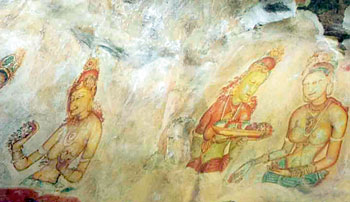
The maidens that adorn the Sigiriya rock have inspired many an ancient traveller to write verses on the famed Mirror Wall

The world-famous Mirror Wall at Sigiriya reveals thriving tourism from ancient days

By Rajitha Weerakoon

Domestic-tourism may not figure as an important component in today’s tourist roadmap. But graffiti scribbled on the Mirror Wall (Kaetapat pavura/kaetabita) at Sigiriya reveal that there had been quite a load of Lankan tourists travelling from as early as the sixth century AD, long before tourism saw the light of day in the West.

During a discussion on Sigiriya when Dr. Raja De Silva, Retired Commissioner of Archaeology forwarded his theory that Sigiriya was a Mahayana monastery and the frescoes were paintings of Goddess Tara, Dr. Roland de Silva, Retired Director-General of the Central Cultural Fund raised the question “Was Sigiriya the earliest tourist-site in Asia?” in which case Sri Lankans would be the earliest Asian tourists? He was quoting from Sigiriya graffiti deciphered and translated into English from the eighth to the tenth centuries AD by Professor Senarath Paranavitana.


The maidens that adorn the Sigiriya rock have inspired many an ancient traveller to write verses on the famed Mirror Wall
But Sigiriya, whether this isolated rock monument was King Kassapa’s (477- 495AD) abode, a representation of God Kuvera’s Alakamandawa or a Mahayana Temple, was an architectural marvel with exquisite decorative work, sculpture, well-planned landscapes, ponds, fountains and a tantalizing art gallery which drew Sri Lankans to the site from many parts of the island.

The spontaneous outbursts left behind in the form of free verses by these random visitors on the Mirror Wall give evidence of the fascination Sigiriya had held for them whose visits extended from the 5th to the 13th centuries with more active visitations being made from the 8th to the 10th centuries. Verses ceased appearing in the 13th century with the jungle tide taking over Sigiriya coinciding with the shift of the capital from the North Central Province (NCP).

Whereas in Europe, Dr. de Silva said tourism was “leisure education” in Greece and Italy for scholars and cultured tourists of colonial Europe and according to the Oxford English Dictionary “tourism was born in the 17th century and the Englishmen were the first to practise it.”

Over thousand years prior to this, it was a cultured lot who made the trek to Sigiriya as well. But what made the Lankan tourists unique was that they left behind verses which expressed their individual views on their visits and their feelings of what they saw in beautiful stanzas on the shimmering Mirror Wall while giving us an indication of the literacy-level that prevailed in the first Millenium.

“(Hail!) the resplendent rock named Sihigiri captivates the minds of those who have seen (it) as if (the mountain) Mundalind, which was adorned by the King of Sages (i.e. the Buddha) has descended on the earth.” (verse 82)

And, “We saw at Sihigiri, the King of Lions whose fame and splendour remain spread in the whole world.” The pride they felt had spilt over to the verses.(verse 37)

About tourist-arrivals they wrote thus: At the present time, hundreds of thousands of householders remain clinging to this. (They) look at this a hundred thousand times in order to impress in their memory what there is at Sihigiri. (verse 130)

The legend of Sigiriya itself may have set the tone as a tourist attraction with its theatrical backdrop of “palace coups,” “court drama” and the predicament of a great King. But what we find is that most of the tourists had become captives of the Sigiri damsels as thousands of verses written in their dedication illustrate.

“Svasti! (Hail!) I am Agboy. I wrote this. Like a vatkol flower entangled in a blue katrol flower, the golden coloured one who stood together with the lily coloured one will be remembered at the advent of the evening!” (Verse 334)

Not only romance but sensual feelings had been expressed in abundance by these early tourists. “Prosperity! When (I) saw the lonely woman, my mind inclined itself (to her and she) took (to herself) my eye. If (you) having seen, have not accepted me (as your lover,) heart was never aflame in former days…”(verse 51)

There had been complaints made too by disappointed lovers: Ah! This (manner of) standing of yours o deer-eyed damsel, is indeed (that) of not having known the (very) name of intimacy…..pleasure has been received by others. When you are come (you say that there is) no intimacy (in me.)”(verse 31)
For those who were curious to know the numbers of damsels that adorned the Sigiriya wall, graffiti written in an earlier period provides the answer. “ ……..five hundred damsels who ( in their) splendour are (like unity) the crest jewels of the King.” (verse 61)

Professor Nimal De Silva, Chairman of the UDA at the time the discussion was held offering his views on the damsels said that the western façade of the rock of 30 by 100 metres plastered and painted was once one canvas and may have looked like a “cheettha redde” (floral-printed chintz) with female figures scattered all over. This delightful mural indeed would have been a feast to the eye of the earliest tourists before it was subjected to the ravages of nature.

But what evidently fascinated the tourists was the mystery that surrounded these voluptuous ladies. “…..the deer-eyed ones do not speak, (remaining) in the self-same manner in which they have severally been painted. I am prince (Apa) Bamdi Dapul” (verse 74)

And of their identity, even those who scribbled verses just a century later from the historically accepted time of Sigiriya origin of the fifth century seemed to have been ignorant of it. Why was their identity shrouded in mystery?

In the relatively recent past, H.C.P. Bell identified the damsels as ladies of Kassyapa’s court going towards the shrine of Pidurangala. Paranavitana suggested that they represent lightning princesses and cloud damsels. Dr. Ananda Coomaraswamy felt that they are apsaras following South Asian tradition while the theory that of Dr. Raja De Silva was that they were representatives of Goddess Tara. Quoting from an ancient text he said, “ Tara holds in her left hand a lotus which she opens with the right hand and she is a heavy breasted lady.” One or two graffitis described the frescoes as Devi or Goddess.

So, while the damsels had guarded their identity for well over 1500 years, most of the tourists had identified themselves, their position/profession and the place or the province from where they arrived. This was an era when travelling was by no means easy and only those who could afford made it to Sigiriya. Thus most were the elite which included royalty, state officials, physicians and ladies of the King’s harem. But there are also verses written by soldiers, metal workers, archers and Bhikkhus amongst others. And they had come from Mahapatanju, Siripiti, Weligama, Ritigala and Polonnaruwa …….from Uturu Pasa, Padi Pasa and Ruhuna.

“Hail! I am Je(t-ma)la, who came from Polonnaruwa. I wrote the verse. …….” (Verse 34)
“Hail! We, the 3 persons who are the apprentices of A(bo)hi Nilal, the olkamuna at (Du) natura-Na-veher wrote this.” (Verse 76)

The Palace Guard Poyal’s song was “having seen (them,) death does not perturb me.” (verse 68)
The pageant of tourists include amongst others Saladala of the house of Ka(na), the keeper of books, Kitala, the guard of the bedchamber from Sapugasa-vati, Agbohi, a washerwoman from Valigam, Lady (Tisa,) wife of Lord K(itag)bo, Lady-in-waiting of princess Jet, Bohodevi, the private secretary of Prince Mihindal and Vijurala-bata from Ruhuna.

The woman from the King’s harem wrote “Hail, I am Friar Sirina, a resident of Tavalpa. Having lived in the King’s harem, we shall certainly not go outside in his absence thus reflecting they are as if they have stopped and are standing looking forward)” (verse 90) – a guess made that the damsels had been women of Kassyapa’s harem.

Some of the verses according to Professor Paranavitana had been written in the fifth century and therefore, one could see the development of ideas over several centuries. A few had been written in Sanskrit and some in the Nagari script around the 9th century. About six verses had been written in the Tamil language between the 11th-the 12th centuries.

These travellers had obviously carried with them the pen of the time – the “panhinda”(quill) – a custom that may have existed among the literate travellers. And some of the verses had been written by tourists while standing and some from the seated position.

The discovery of miniature terracotta figures of Sigiriya damsels during excavations is a reflection of the kind of tours that existed which illustrates that in the first millennium, tourists had been carrying away even souvenirs that represnted Sigiriya. Perhaps there were souvenir-sellers doing brisk business with the loads of tourists who were visiting the site?

While “hundreds of thousands” had been climbing the hill, there had not been an absence of concern among the tourists about pollution as this verse indicates: I know also how Sihigiri had been ruined by these (people.) Stop, o faithless ones as there are more people with good taste.” (verse 81)

Tuesday, May 31, 2011

They call it ‘the voyage of the damned’. But thousands still want to try it

A new beginning
Australia and Canada are the preferred destination of the Sri Lankan refugees

Photo: AFP

Sri Lankan refugees in India are ready to do anything to escape their camps. Sai Manish finds out why

IN THE 1980s, Sri Lankan Tamils escaped to India from the ravages of a bitter war in the island nation. Now they are fleeing India for a better life in the West, undertaking a mindnumbing 3,000 nautical mile journey into a watery void so perilous that many call it the “voyage of the damned”.

“I was hoping to get on the last ship but the agent says the seas are rough and I can go only after the rains are over,” says Manikandan, 28, who stays with his father in one of the largest refugee camps at Mandapam in the coastal district of Ramanthapuram. “I have already paid Rs 20,000 and will pay another Rs 80,000 when I reach Australia. My brother and his wife are there on Christmas Island at the special camp and he will soon be given asylum. I came from Trincomalee four years ago but I can’t spend the rest of my life living on doles and doing odd jobs. I’m a graduate and I deserve better.”

Hundreds of youth like Manikandan are putting their life in jeopardy to make a precarious journey across the Indian and Pacific Oceans to Australia and Canada in search of a better life. Given the desperation to rebuild lives, many nefarious agents, some with the backing of Tamil Nadu’s fringe political groups, are luring gullible refugees with the promise of paradise across the seas.

TEHELKA spoke to a Chennai-based agent and a few refugees who have already paid a part of the Rs1.5 lakh fee to be shipped illegally. The agents, most of whom are Sri Lankan nationals settled in India as refugees, have easy access to the 73,000 refugees living in 115 camps.

The agents say that they always impose some conditions before the journey. “Rule No. 1 is that there should be no old men and women on board the ship. No. 2 is that no transit to Australia and Canada is made without infants on board. No. 3 is that if someone dies on board, his/her body should be promptly disposed of at sea. No. 4 is when they reach the destination, they should maintain that they fled from Jaffna and not Tamil Nadu.”

An infant on board ensures preferential treatment from western authorities to asylum-seekers when they are detained. “In Australia, it takes just two months for women with babies to be released and given asylum after detention. I have friends who had an arrangement with girls in the camps to bear their children. It makes it a lot easier,” says Edward Kumar, a refugee in Chennai.

The agents buy dilapidated fishing boats, some barely sea-worthy, known among the refugees as ‘rollers’ after tales of such boats rolling over mid-sea killing everybody onboard. There are no crew members or safety jackets. Five youth are chosen to steer the ship. The voyage takes 14 and 45 days each to reach Australia and Canada respectively.

“Food is scarce and we have to ration it. Usually just bread, jam and pickle that don’t get spoilt. Some agents are generous enough to provide milk powder and baby food. But the food barely lasts the trip. Everybody sleeps huddled together below the deck,” says Edward.

The boarding points can be anywhere along the coast of Tamil Nadu or Kerala and is usually a well-kept secret until the day of the journey. However, due to heavy patrolling, many agents are putting people on fishing boats in the dead of the night before transferring them mid-sea on to a waiting ‘roller’.

“The modus operandi of the agents has changed after intense patrolling by the Coast Guard and Indian Navy off the Palk Straits during and after the war in Sri Lanka,” says a senior officer of the Q Branch CID, a special cell of the Tamil Nadu Police that keeps a tab on the activities of Lankan refugees in the state.

“It is difficult to determine the boarding points. Now many are trying to leave from Kerala to avoid detection,” says the Q Branch officer. “Last year, we received information that 38 refugees were to set sail from Kollam. They were detained and it was revealed that they had paid nearly Rs 5 lakh to agents to ferry them to Australia. Since then we have clamped down on such human traffickers.”

In 2010, the Q Branch busted close to eight networks that were planning to smuggle out nearly 1,000 refugees. On 26 January, after intercepting a car in Ramanathapuram suspected to be carrying human smugglers, officers were stunned to find 500 g of heroin, 22 carbines of .9 mm calibre and a satellite phone.

Agents tutor the refugees to claim that they fled from Jaffna and not Tamil Nadu

“Most of the agents are dangerous and they are duping the refugees. Many refugees are dumped at godforsaken islands. We are making refugees aware of such unscrupulous people and to avoid them at any cost,” says SC Chandrahasan, director of the Chennai-based Refugee Rehabilitation Organisation.

Despite the hostility to these ‘boat people’ in countries like Australia and Canada, most still think the risk is worth it. For instance, Australia stopped processing claims of Sri Lankans and detains them at a notorious camp called Christmas Island, even packing off people under naval escorts to Malaysia under a refugee-swapping agreement. This hardline stand has forced many to undertake journeys to France where Rule No. 4 assumes utmost importance for being granted asylum. Meanwhile, Canada is rethinking its strategy after a suspected LTTE renegade was found aboard a ship that landed at Canadian shores last year.

SINCE MOST asylum-seekers destroy their ID papers, in the absence of inter-state information sharing, it becomes impossible to ascertain whether the refugees are from India or Sri Lanka. Even the United Nations Human Rights Commission (UNHCR), which is facilitating the return of Tamil refugees to Sri Lanka, is surprised that many are choosing to undertake this journey of death.

The UNHCR says that conditions in Jaffna and other Tamil-dominated areas that bore the brunt of war “are returning to normal and there is no need for groupbased protection and presumption of eligibility as asylum-seekers for Sri Lankan Tamils”. However, many who fled for their lives during the war feel the need to escape for their livelihoods now.

“I can get good education in India but my refugee status does not allow me to take up a job commensurate with my education,” says Kutty, a refugee from Mandapam. “Most of us work as coolies or daily-wage labourers and have to report back for a headcount by sunset. What is the point in continuing this existence if I can’t even gift a gramme of gold to my sister for her marriage? And I don’t trust Mahinda Rajpaksa enough to take the risk of going back to Sri Lanka. I would rather die trying to secure a better life for my family than go back to my homeland.”

For many of the young and restless, tales of the good life stream in from those who managed to get asylum. And for those waiting in the wings, tales of watery graves are no deterrent before they sign up for the “voyage of the damned”.

sai.manish@tehelka.com

Thursday, May 12, 2011

Sweeping changes as women sign up for mine-clearing jobs in Sri Lanka

Ben Doherty
May 11, 2011


SINNAPANDIVIRICHCHAN: The women are taking back war-torn northern Sri Lanka, one square metre at a time.

In some parts of the Tamil-dominated north, women are said to outnumber men by 10 to one. In the aftermath of the brutal civil war that cruelled this part of the country for the best part of three decades, the men are dead, held by the army in isolated internment camps, or have simply disappeared.
The war is over, but with as many as 40,000 civilians killed, the UN estimates, much of the north is still barely populated and hardly rebuilt.

An important reason is a land still blighted by mines. Both sides of the Sri Lankan conflict laid mines, but the number is unknown. The best estimates suggest it is in the hundreds of thousands.

For decades during its separatist war against the government, the Liberation Tigers of Tamil Eelam - known to the world as the Tamil Tigers - had jungle factories turning out thousands of landmines a week. The army laid its own fields.
Now the fighting is over, young women are the sole breadwinners in thousands of families and they are taking up one of the few jobs going: the difficult and dangerous task of clearing their scarred land, mine by mine.

Yogalingam Rubaganthy, 29, a mine clearer for a year, is helping train the second all-woman clearance team being run by the British Mines Advisory Group (MAG), funded by AusAID.

''It's difficult work. It's hot and it's dry and it is difficult to be in the field all day [and to] concentrate,'' she said. ''But [it] is possible for women to do the work; they have the ability.''

Rubaganthy lost her father, a sister and two brothers when her home in Killinochchi was shelled. She has one younger brother left, who is now back at school. ''That's the main reason we are all here,'' she says. ''We have responsibilities for our families. I must look after my family now.''

She sees benefit for the country, too. Fleeing the fighting, Rubaganthy spent months in an internment camp.

''The camps are not a nice place to live, and many people are still there,'' she says. ''They need their lands free from mines so they can come home; come back to [their] livelihoods.''

Clearing Sri Lanka's mines is especially difficult because of the way the war was fought.

The Tamil Tigers spent years laying vast minefields in an attempt to build a physical barrier that would separate the Tamil-dominated north from the Sinhalese south. But in the final weeks of the conflict, as they fled the advancing Sri Lankan Army, the Tigers took to so-called nuisance mining - laying mines without a pattern.

They deliberately laid mines around trees, near houses and wells, or on paths - any place where troops and people would be likely to tread.

MAG's technical operations manager, Magnus Rundstrom, says clearance teams scour villages first. The next priority is farmlands. Most people here rely for a living, to some degree, on what they can grow on their land. There are mines laid deep in the jungle too, but these are a lower priority. .

Rundstrom says that in conservative Sri Lanka it would be inappropriate for female mine clearers to work alongside men, ''but the training they receive is exactly the same, and the work they do is exactly the same''.

At 24, Egambaram Renathani is head of her household. She is being taught how to check for tripwires; to gently scrape beneath the earth, checking for mines. ''I am learning for one week,'' she says. ''It is difficult but it is important for my country. I am proud to do this job.''

Tuesday, November 30, 2010

Sri Lanka's alternatives abroad

By: Kitana Ananda, V V Ganeshananthan & Ashwini Vasanthakumar

There is no such thing as 'the Sri Lankan diaspora'. Sri Lankan communities exist in the plural. And yet, nearly thirty years of conflict have rendered a nation with multiple minority communities and religions as though it has only two groups. If you generalise about what you read at all (and most people do), you are likely to believe that Sri Lanka's Sinhalese majority and Tamil minority are pitted against each other, not only inside the country but in diasporas all over the world.

While conflict and geographic dispersal present real challenges to Sri Lankan diasporas, this image of Sinhalese versus Tamil is far from the whole truth. Although the war ended with a decisive victory by government security forces over the LTTE in 2009, the reductive image remains: Sri Lanka, a nation with Sinhalese, Tamil, Muslim and Burgher communities, rarely appears that way. The media is not the only culprit. In the wake of that resounding military victory, both the Sri Lankan government and its critics have failed to engage Sri Lankan diasporas and to understand their complexity. Indeed, their collective actions have excluded diasporic populations.

Lankan diaspora histories often begin with 1983, when anti-Tamil violence and the rise of Tamil militancy led to the civil war that displaced hundreds of thousands of Tamils from the island. In fact, a longer and more complicated history of migration is responsible for today's Lankan diasporas. During the 1930s and 1940s, English-speaking upper-caste Ceylonese who worked in the British Empire's civil service formed diasporic settlements from Burma to Malaya.

After independence in 1948, new legislation disenfranchised Tamils of Indian origin, who had been brought in to work on colonial plantations during the late 19th and early 20th centuries. Many members of that community were subsequently repatriated to India. An attempt to nationalise government administration with the 1956 Official Language Act ' popularly dubbed 'Sinhala Only' ' led to the migration of Ceylonese professionals of all communities who were not proficient in Sinhala. Large numbers of Burghers, the community of mixed Sri Lankan and European descent, migrated to Britain, Canada and Australia; Sinhalese, Tamil and Muslim professionals followed, accompanied by their families.

In these transitional decades, there was no such thing as a Tamil or Sinhalese diaspora; but by the late 1970s this was no longer the case, as factionalism escalated within the country. Three decades of state and economic restructuring had not created a united 'Sri Lankan' nation, and tensions mounted between a Sinhalese-dominated government and Tamil political parties. Disaffection with the political status quo gave rise to a 1971 insurrection among predominantly rural Sinhalese youths in the south, and growing militancy among Tamil youths in the north and east by the latter part of the decade. University admissions quotas, among other policies, effectively reduced opportunities for middle-class Tamil students and young professionals, who began to seek employment abroad.

Diasporas today
In July 1983, nearly 3000 people were killed and thousands more displaced over five days of government-sponsored anti-Tamil violence, creating a new wave of migrants. The scale of destruction and spectacular displays of enmity spurred sympathetic Western governments to create special categories for refugee resettlement. As the country descended from ethnic conflict into full-scale war between the government and Tamil militant groups, the tide of migration continued. In the 1980s, as the LTTE rose to supremacy by brutally eliminating other Tamil militant groups, non-LTTE Tamil militants and their families emigrated. Internally, too, the country saw mass displacement of Muslims and Tamils.

The war with the state intensified through the mid-1980s and 1990s, again prompting hundreds of thousands of Tamils to depart. By some estimates, nearly 900,000 ' one in three ' Tamils from Sri Lanka today live abroad, hailing predominantly from the country's north and, to a lesser extent, the east. India was often their first stop and, for some, their final destination. Others headed to Canada, the United Kingdom, Australia and the United States, each of which offered the possibility of citizenship. Others remain refugees in India, Southeast Asia and Europe. As the war escalated, the pro-LTTE section of the diaspora became famously militant, pouring money into the Tigers' movement, while their relatives and friends back home lost children, homes and livelihoods. The Tigers even developed an overseas wing, which managed its propaganda so successfully that other sections of the Tamil diaspora were virtually erased from the public sphere.

Admittedly, the largest Sri Lankan diaspora is a Tamil one, which has commanded considerable attention as a result of post-1983 migration, the war, and visible propaganda and financial support for the LTTE among some of its sections. Some use Sri Lankan diaspora and Tamil diaspora interchangeably, but Sinhalese and Muslim Sri Lankans have also gone to other shores amid political crises and economic uncertainty, and they continue to emigrate, predominantly as temporary migrant workers to West Asia. Sizeable and diverse Sinhalese diaspora communities have formed ' among workers in Italy, professionals in the United States, and several generations of migrants to the United Kingdom and Canada.

Today, some Sinhalese (and, to a lesser extent, Muslim) groups maintain ties with each other and with Sri Lanka through various associations. For some organisations, 'Sri Lanka' becomes a proxy for displays of Sinhalese nationalism that make critiques of the Sri Lankan government difficult. Similarly, prominent diasporic Tamil organisations have long showcased arguments for separatism, sometimes accompanied by endorsements of the LTTE. Those who do not agree with these respective lines face isolation from their own ethnic communities.

In May 2009, the war's end saw the differing trajectories of these diasporas converge in tense confrontations in Canada, the UK, Australia and elsewhere. Thousands of Tamils around the world protested the war and the suffering it imposed. Those waving LTTE flags monopolised media attention, sidelining the message of 'peace through negotiations' emanating from other quarters. In response, smaller Sri Lankan groups with close connections to embassies and missions abroad organised counter-demonstrations. Their predominantly Sinhalese ranks also included anti-LTTE Tamils who cheered the Tigers' defeat and hailed the soldiers who ended the war through military action.

Just remittances, please
Over the course of the war, the visibility of dominant sections of the Tamil diaspora ' and their stunning vocal and financial support for the Tamil Tigers ' has helped the Sri Lankan government to project the entire group as a terrorist threat. Post-war, the authorities' attempts to derail a monolithic 'Tamil diaspora' have transformed into interest in that diaspora's sizable collective wallet. In anticipation of a post-war Lanka, the government handpicked leaders and activists of the Tamil diaspora to attend a March 2009 conference in Colombo. At the meeting, dubbed the Sri Lankan Diaspora Dialogue, many of the invitees expressed dismay with the government's heavy-handed agenda. Even as the government invited some Tamils to return to the island, it has made the following conflicting claims: The LTTE has been completely decimated; the LTTE could re-emerge at any time, and has powerful supporters abroad; the diaspora is invited to engage with us financially; we are no longer a colony, and those who criticise us from abroad have the mindset of colonisers (or support the LTTE).

The LTTE's claim to be Tamils' 'sole representative' ' and its well-known allies abroad ' is convenient for the government, which wants remittances, not opinions. If it links all its overseas critics to the Tigers, it can dismiss their concerns. As pro-LTTE activists in the diaspora say they will continue to fight for Eelam from abroad (the most visible iteration being the Transnational Government of Tamil Eelam, formed in May following a diaspora-wide election), their statements fuel Colombo's ire. In retaliation, the government has announced local and international campaigns to gather intelligence, seize assets and shut down the LTTE's remaining international network. In such a climate of suspicion, the government has been quick to conflate any criticism with support for the LTTE, leaving no room for serious diasporic engagement with the state.

On the other hand, the government does recognise diasporas' economic and political power, as well as the effectiveness of pro-LTTE activists overseas who have made it difficult for their critics to speak out. Indeed, since the Diaspora Dialogue, Colombo has learned much from the LTTE's hegemony in diaspora communities. The government sidesteps political criticism by appealing to the desire of many to aid the war-torn regions of north and east Sri Lanka. To initiate development projects in these areas, it turns to ex-members of the Tigers. Former Tiger arms procurer and international-affairs representative Kumaran Pathmanathan now sits under house arrest in Colombo, dispensing advice to the government; his own public rehabilitation was announced with the launch of the North-East Rehabilitation Development Organization, for which he claimed 'the Tamil diaspora' was ready to work with the president. In the Eastern province, former Tigers and current government officials Pillayan and Karuna have their names bandied about as evidence of state engagement with minorities.

The power of foreign exchange as a potent resource for post-war reconstruction is not limited to the Tamil diasporas alone. With the war's end, Sri Lankan embassies have raised funds (more than USD 690,000 to date), mainly from Sinhalese entrepreneurs and organisations, for Api wenuwen api (Be together for all), a Ministry of Defence campaign to build 50,000 houses for soldiers. Opposition groups also mobilise Sinhalese diaspora communities for their own ends. For example, in September, Sinhalese workers in Italy protested the Colombo government's continued detention of the former head of the Sri Lankan armed forces, Sarath Fonseka.

The government's latest statements continue to entreat 'the Sri Lankan diaspora' to participate in economic development. At the Asia Security Summit in August 2010, Minister of External Affairs G L Peiris said, 'Our message to the diaspora in the Western world and elsewhere is that they have a dynamic role to play; we do not want them to distance themselves from the exciting developments which are taking place in Sri Lanka today.' Such pronouncements are made even as the government cracks down on dissent and political opposition within Sri Lanka, and invokes the spectre of threats to national security to silence activists abroad. Peiris, a chief negotiator during the Oslo peace process, has recently argued that earlier talks and attempts at political reform failed due to a lack of consensus among dominant political interests. This top-down approach has allowed generations of Sri Lankan politicians to suppress debate and dissent while claiming to remain committed to political reform, and the same technique is now being used to mobilise the diaspora communities' economic power.

This dual approach to (particularly) Tamil diaspora communities dismisses legitimate grievances and criticisms. Simultaneously, it invites potential investors to capitalise on the war's end and selectively wields former LTTE leaders to collect economic contributions from the former. This not only privileges the economically secure and undermines the political engagement of diaspora communities in general, but also silences the many moderates ' in-country and abroad ' who did not provide unqualified support to the narrow agendas of successive governments or the LTTE. Such groups could not publicly criticise these agendas before, nor are they able to do so now. Instead, they remain sceptical and watchful of the many projects undertaken in their name.

Discounting nationalism
The government's dismissal of the Tamil diaspora as being little more than LTTE henchmen is not surprising. It is less encouraging, however, when the same attitude is revealed in progressives' discussions of, and engagement with, the diaspora. The left has largely disengaged from diasporic politics, preferring to direct its limited energies to the battles to be waged in-country. But this myopia prevents engagement with the considerable resources of moderates within the diaspora.

During the war, progressives from all communities attempted to create space within the diaspora from which exclusivist nationalism could be challenged. Emphasising marginalised histories to refute nationalist narratives, these activists deployed the language of human rights and political pluralism. But they largely engaged with diasporic politics because of its importance to politics in Sri Lanka. Now, in the aftermath of the Tigers' defeat, this effort has atrophied. And by equating the Tigers' totalitarian politics with Tamil nationalism and the government's brutal tactics with Sinhalese nationalism, the left only reaffirms these actors' respective claims to represent Sinhalese and
Tamil peoples.

This cedes important ideological and political ground. Furthermore, by depicting nationalism as static, regressive and exclusivist, the left fails to appreciate the varieties of nationalism, its potential as a source of solidarity, and its importance in forging and transforming identities. Indeed, national identity is what ties those in the diaspora ' including progressives who would rather identify themselves as expatriate or exile ' to politics in Sri Lanka. But from the diaspora various nationalisms can also emerge, where the multiple identities and affiliations of those in the diaspora can fruitfully inform and expand nationalist politics in Sri Lanka. Many Tamils were privately critical of the LTTE's tactics; many Sinhalese were critical of the state's growing authoritarianism. Clearly, between the poles there is space for common ground.

Progressives fashion themselves as exiles who, after years in the ideological hinterlands of the diaspora, can return to Sri Lanka and resume agitating for the transformations they failed to secure thirty years ago ' as though those intervening decades did not happen. What this has meant among many leftists in exile is supporting a project of authentic nationalism ' for some ethnic, for others, multi-ethnic ' from abroad, without engaging the communities living in their midst.

Responsible resource
The Colombo government will not successfully engage diaspora communities in large-scale reconstruction if it continues to approach them in the same manner as it did throughout the war. Without a political process aimed at ending minority grievances on the island, many Tamil expatriates will continue to view the government's embrace with scepticism. More fundamentally, diasporas should not be engaged only because they are deemed useful to 'real' Sri Lankan political actors engaged in the serious business of realpolitik. Rather, diasporas should be recognised as legitimate arenas of Sri Lankan politics. To claim otherwise is to reward regimes that neutralise political opposition and silence dissidents by expelling them.

For their part, members of Sri Lanka's diasporas need to begin a process of critical reflection regarding the last thirty years of war, something that was discouraged amidst calls for solidarity. Instead of forgetting the so-called 'tragic decades of nationalism', communities across the political spectrum need to consider their complicity in its crimes, their complacency in the face of its manifest excesses, and their failures in advancing compelling alternatives. Such efforts might be most effective in Sri Lanka, and have begun in various fora there; but, given the significance of the diaspora in Sri Lankan politics and the relatively greater freedoms enjoyed outside Sri Lanka, it is imperative that these conversations happen outside too, and happen publicly.

This political reflection is especially important as the Sri Lankan government woos overseas communities for economic contributions, and contributions alone. Many are understandably excited by Sri Lanka's post-war economic prospects. And in some respects, economic involvement can be more tempting than political engagement: its requirements are more discrete, its rewards more apparent, and it can look refreshingly (if deceptively) apolitical. In reality, of course, economic development in post-conflict Sri Lanka is subject to intense contestation, with economic fortunes inevitably linked to political positioning (see Himal Oct-Nov, 'Capitalism contradictions'). Alternatively, the economic clout of responsible diasporic investors can ensure that the war and its bloody aftermath do not get airbrushed away, as in the glossy picture the government and its uncritical allies are so eager to promote.

The diaspora can also promote reconciliation by mirroring it abroad. In the absence of reliable media coverage from Sri Lanka, youth overseas have been too easily radicalised by incomplete histories and half-truths. This can only be countered by collective action to share stories and political pasts. As those private conversations become public, salient criticisms can gain traction through coalitions of progressive voices. Sinhalese, Tamil, Muslim and Burgher activists forming alliances overseas can become a powerful medium for critique and change. Those critical of diasporic extremists have rightfully called for grounding, and for true accountability to those on the ground in Sri Lanka. With action comes responsibility: if we want to work within Sri Lanka, we must listen to those who live there. Sinhalese and Tamil activists abroad must note that certain populations marginalised inside Sri Lanka ' for example, Muslims, Burghers and Up-country Tamils ' are correspondingly underrepresented in the diaspora. Their interests are Sri Lanka's interests, and critique of the country must consider and engage them.

Sri Lankan diasporas are an easy target. They are easily ridiculed, their most vocal members often spouting opinions that seem ignorant. Their memories of grievance and grief are embarrassingly fresh, their suggestions oversimplified and trite, their language loaded. Their physical absence from Sri Lanka seems to preclude their involvement in its political life. Their hyphenated identities and modified accents undermine their authenticity. They are not really Sri Lankan ' that is, at least, when they do not serve the interests of the 'authentic' political actors in Sri Lanka. But they are also an unrivalled resource, with legitimate claims to space in Sri Lankan politics, and filial and financial ties to the country. They genuinely care about Sri Lanka and, in a world with increasingly porous borders, they have every right to do so. Their transnational politics is a product of the war, and they remain connected to Sri Lanka, even though their homes are abroad. Can the country afford ' from a practical or moral standpoint ' to turn its back on a million people who could contribute to its future?


The Hindu Deputy High Commissioner of Sri Lanka in Southern India Vadivel Krishnamoorthy handing over birth certificate to a Sri Lankan Tamil at a special camp at Virudhunagar on Saturday. Treasurer of Organisation for Eelam Refugees Rehabilitation S. C. Chandrahasan (third from right), is in the picture. Photo: K. Ganesan
Tuesday, November 16, 2010

Sri Lankan Maids Become Victims in Saudi Arabia

Razeena, left, and Mohammed Nafeek, the parents of Rizana Nafeek, a Sri Lankan maid sentenced to be beheaded after a baby died in her care in Saudi Arabia, are pictured in Colombo on July 16, 2007
Spending five years in a Saudi Arabian jail while facing death by beheading would be traumatic for anyone, let alone for a 17-year-old thousands of miles away from home.

But that's exactly what Rizana Fathima Nafeek, who moved to Riyadh from Sri Lanka to work as a maid, has endured since 2005. Nafeek, now 22, has spent the past half-decade in a Riyadh prison facing a death sentence in a country where she does not speak the language and where she does not have any relatives. Her job, obtained through a Sri Lankan recruitment agency, was supposed to be the ticket out of abysmal poverty for her family, says her mother, Razeena Nafeek. The family of six found it hard to get by on the income that Mohammed Nafeek, her father, earned as a woodcutter in the remote village of Muttur, east of Colombo. "We pinned all our hopes on the job," she adds.

But that opportunity turned into a nightmare just one month after Nafeek — who, at 17, carried forged documents that said she was above the legal working age of 18 — began her job in the Saudi household. Her employers accused her of murdering their 4-month-old infant. Nafeek later told her mother that the child accidentally choked while being bottle-fed by her. She had no prior experience taking care of a young child, her mother said.

Nafeek was found guilty of the charge and sentenced to death — a conviction that rights groups say was based on a confession made under duress and the forged passport that changed her status to that of an adult. But last month, the sentence was upheld by Saudi Arabia's highest court, prompting a fresh wave of calls from Sri Lankan President Mahinda Rajapaksa and international rights groups, including Amnesty International and the Asian Human Rights Commission (AHRC), for Saudi Arabia's King Abdullah bin Abdul Aziz al-Saud to pardon Nafeek. The European Union and the U.N. Office of the High Commissioner of Human Rights have indicated that they, too, will be making similar appeals. If the King ratifies the sentence, then execution by beheading would be imminent.

Nafeek's may be the most high-profile case facing a Sri Lankan domestic worker in the Middle East, but it is not the first and will not be the last. In 2009, over 77,000 Sri Lankan women went to the Middle East as domestic workers, and some 42,000 went to Saudi Arabia, according to that government's statistics. Sri Lankan women working abroad play a vital role in the Sri Lankan economy; of the nation's over 1 million overseas workers, women's paychecks accounted for more than half of the $3.4 billion sent back to Sri Lanka in foreign remittances last year.

Like Nafeek, most of these women come from the nation's poorest families and hardly have any prior work experience. The unskilled nature of their work and expectations of their employers can make for a volatile work environment, often complicated further by the lack of a common language. "Sri Lankan migrant workers face a multitude of obstacles at all stages of the migration process: predeparture, in service, and upon return and reintegration," says Pramodini Weerasekera, a program officer with the International Labor Organization, which is advising the Sri Lankan government on enhancing training networks and sending more skilled workers abroad. "Many of these issues stem from the skill-level profile of Sri Lanka's migrant workforce where the majority of workers fall within the low-skilled and housemaid categories."

In 2009, there were 4,500 complaints lodged by maids working in Saudi Arabia to Colombo's Foreign Employment Bureau. Most complaints were about a lack of communication, sexual harassment or no payment of wages, but some were much worse. Last week, a domestic worker who returned to central Sri Lanka from Jordan reported being forced to swallow at least six nails. Over the weekend, another woman who returned from Kuwait had 14 nails removed from her body at a hospital in the central Sri Lankan town of Kurunegala. These cases follow close on the heels of yet another gruesome story: in August, 50-year-old Lahanda Purage Ariyawathie, a grandmother of two, returned to Sri Lanka from Saudi Arabia five months after accepting a job as a maid. Her body was dotted with small, oozing wounds. Doctors later removed over 20 nails and needles that had been embedded in her body. Ariyawathie said that hot nails were embedded in her body by her Saudi employers who were dissatisfied with her work. Saudi authorities have rejected the claim.

Ariyawathie says that language — or the lack of a common one — was the main cause of her troubles. "They did not understand what I said, and I did not understand what they said. They asked for lime, and I would bring tomatoes," she says. Her alleged torture sequence began after about two weeks at the household, when her employers' patience ran out. She says that the woman would hold her while the man inserted the hot nails into her. Months later, she was released from the job and returned home when her wounds did not heal and began to fester.

The inability to communicate appears to be a big factor in Nafeek's case as well. Her family says she does not speak Arabic, and they are unsure whether she received any training before her departure. She could not understand the court proceedings, according to Basil Fernando, director of policy and program development at the AHRC.

The Hong Kong–based advocacy group has been paying for Nafeek's legal help during the appeals process. "We just want our daughter back. She has suffered enough," says Nafeek's mother. The family spoke to Nafeek during the last week of October. She sounded frightened and scared, still waiting to hear when and if her sentence would be carried out. "She does not know whether it is likely to be anytime soon or whether we have some more time," says her mother. "Neither do we."

Fortunately, those who are closely monitoring the case like Fernando say there is still hope for Nafeek. Available evidence, including Nafeek's retraction of her confession made to police, suggests that the infant died due to an accident, and the sentence is being evaluated by an adviser to the Saudi King. One opposition MP has told Nafeek's family that the Saudis are expected to make a favorable decision after the hajj pilgrimage ends later this week, due to international appeals.

But, AHRC's Fernando cautions that Riyadh has carried out sentences without any prior warning in the past. As Nafeek's family waits in fear for any news, hope for leniency for their daughter has replaced the wish for a better life. "We don't want anything," says her mother, fighting back tears. "We just want her back."

Wednesday, October 20, 2010

Book Review - Chinaman

Where in the world is Pradeep Mathew?
An ambitious, inventive, must-read new novel from Sri Lanka


There are at least two types of book readers. (I refer to the people who read books and not those new-fangled devices.) The first type read their books in one go, rarely pausing for rumination, reflection or any handwork with pencils or highlighters. If at all, they reflect on the book after they're done reading.

Then there is the rare type - those who cannot read a book without obliterating it with dog ears, notes in the margin, underlined passages and bookmarks. They convert the reading experience into a process. Perhaps they even stop every few minutes to tweet out interesting lines.


If you are one of the latter, you will take days to get through young Sri Lankan author Shehan Karunatilaka's Chinaman. That is even if you really want to finish this brilliant book as quickly as you possibly can. With clever lines on every page, Chinaman is the most tweetable book I've ever read.

In hindsight it appears to me as if Karunatilaka wrote the book with a checklist in his mind: "That's one more page done. Do we have a joke? Check. A brutal dig at cricket? Check. An irreverent swipe at Sri Lankan culture? Check."

A superb work of fiction blended with non-fiction that makes you sit up night after night reading it? Double check.

Chinaman is, mostly, the story of a Sri Lankan journalist's hunt for a long-forgotten, and fictional, Sri Lankan cricket player called Pradeep Mathew. Mathew has a brief, meteoric cricketing career in the late 80s and early 90s that sees him achieve superhuman bowling records. But he vanishes as quickly as he appeared.

As the curious, and increasingly obsessive, journalist, Karunasena, begins to peel back the layers of Mathew's life he realises something is amiss. Mathew has vanished not just from the cricketing scene, it appears he has ceased to exist. His existence has even been expunged from the record books. And there is something disturbingly Orwellian about it all.

Yet Karunatilaka's book is equally about Karunasena. I wish I knew more about the author to see how self-referential this character is. Or maybe they just share Karunas. But the character of the 64-year old journalist is a wonderful device to place the topic of Sri Lankan cricket within the larger themes provided by Sri Lankan society and history.

So on the one hand there is the obsessed, alcoholic journalist, well into the twilight of his career, going in search of a human mirage. But on the other there is the very real world that this journalist occupies. One of his friends is a diplomat who may have an ugly secret that involves little boys. Yet another is a member of Sri Lanka's Burgher minority, who is as obsessed with cricket as Karunasena is. And somewhere in the final third of the book a bomb explodes at a train station. It happens casually, the death toll described as if in an afterthought.

Most of all Chinaman is a book about cricket. Karunatilaka has crafted a thinly veiled version of modern cricket, complete with reviled commentators, horny cricketers, loose women and big, bad money.

Did I say the veil was thin? I meant to say it is almost transparent. One of the book's minor characters is the Turbanned Indian Commentator. Mentioned frequently enough so that after a while he is just referred to as TIC. Earlier in the book there is a beefy English cricketer, whose idea for a documentary is what really kicks off the hunt for Pradeep Mathew. His name is, but of course, Tony Botham.

Karunatilaka skewers cricketers old, new, good and bad, all in style. And with prose that is infectious. Once you get past the first 50 pages, which are the slowest but not by much, the book is - no cliché intended - unputdownable. The mysteries of Pradeep Mathew, combined with the brutal dissection of cricket and the delicious morsels of cricketing trivia come together to form one of the strongest, most immersive plots in a sports novel, or indeed any novel, I have read in a long time.

The book is not without its gimmicks. There are a few towards the end that are particularly laboured. And there are a few occasions where the dialogues seem too smart by half. But all good innings have room for a few hoicks over slip. And Chinaman is a Test match-winning innings-at-the-death watch-over-and-over-on-Youtube kind of a book.

At least one commentator has called Chinaman the first great Sri Lankan novel. Perhaps it is. It certainly is a superb novel. For all cricket fans, especially those from the subcontinent, it is a compulsory addition to their library.

And if you can't stand cricket, this is still a book well worth reading. For sheer scope, ambition and inventiveness. Karunatilaka has smashed this out of the park.


Chinaman: The Legend of Pradeep Mathew
by Shehan Karunatilaka

Random House
Currently available in Sri Lanka and online. An Indian edition of this book, due out in January 2011, will be available across the subcontinent

Thursday, October 7, 2010

Horton Plains Slender Loris pictured for first time

This cute furry primate is the first of its species to ever be photographed.

One of the world’s rarest primates driven to the brink of extinction by Britain's taste for tea has been photographed for the first time, scientists said.

The Horton Plains slender loris has been so elusive for more than 60 years scientists believed the wide-eyed mammal had become extinct.

It had only been seen four times since 1937 but was fleetingly spotted in 2002 by researchers who identified it by the reflection of a light shone in its eyes.

Experts believe the prime reason for its rarity was due to the loss of its natural forest habitat largely destroyed by the drive to create tea plantations.

Now scientists from the Zoological Society of London's (ZSL) edge of existence programme have managed to capture the world's first pictures of the rare animal during research aimed at quantifying how many species remain in the wild.

The picture of the endangered mammal shows an adult male Horton Plains slender loris, characterised by short limbs and long dense fur, sitting on a forest branch.

It was captured after more than 1,000 night time surveys in Sri Lankan forests taken during 200 hours of painstaking work.

The team not only took pictures of the animal but also captured three live specimens long enough to measure them.

"We are thrilled to have captured the first ever photographs and prove its continued existence - especially after its 65-year disappearing act,” said Dr Craig Turner, a ZSL conservation biologist.

Slender lorises, officially known as Loris tardigradus nycticeboides, are small nocturnal primates which are only found in the tropical forests of southern India and Sri Lanka.

They are about 6-10 inches long (15cm-25cm) and have large saucer-like eyes which help their night-time hunting.

Estimates suggest there are just 100 of the endangered creatures left in the wild, putting it among the world's top five most threatened primates.

But researchers admitted that so little was known about them that numbers could in fact be below 60, which would make them one of the rarest breeds in the world.

Friday, October 1, 2010

Comparing cricket with baseball is a good way to start a spat


Harold Pinter, the late English Nobel Prize-winning playwright, espoused the pleasures of cricket when he said: "I tend to believe that cricket is the greatest thing that God ever created on earth. Certainly greater than sex, although sex isn't too bad either. Anyway, you can either have sex before cricket or after cricket. The fundamental fact is that cricket must be there at the centre of things."


BRITAIN and America are divided, not just by a common language, but also by their passion for summer ball games. The English dismiss baseball as a barbarous mutant form of rounders, a kids’ game; Americans regard cricket as a crazed English joke. Matthew Engel, a cricket writer, notes that “It is less contentious to write about religion or politics than the origins of these two games.”

Early in the 20th century Albert Spalding, an American sporting-goods manufacturer, insisted that baseball had been invented in Cooperstown, New York, in 1839 by a young soldier called Abner Doubleday who would be promoted to major-general during the American civil war. Baseball’s Hall of Fame was opened in Cooperstown when a misshapen leather ball found in the attic of a house near the town in 1934 was heralded as the ball originally used by Doubleday. This was always an unlikely tale, and Spalding’s papers, which are now housed in Cooperstown, expose his claims as a fabrication.

The true origins of both games are to be found in “Swinging Away: How Cricket and Baseball Connect”, a new exhibition for which the curator, Beth Hise, has written an exemplary catalogue. This cornucopia of bats and balls, uniforms (belonging to England’s Andrew Flintoff and the Yankees’ Derek Jeter), photographs and memorabilia has opened at the Marylebone Cricket Club’s museum at Lord’s Cricket Ground in London and will move on to the Hall of Fame.

It is based on the revisionist notion that the two games have much in common. Both are rooted in English folk traditions, and each is based on a contest between the pitcher and the batter in baseball and the bowler and the batsman in cricket. Referees are called umpires in both. “I see them as blood brothers, separated at birth but genetically linked,” writes Mr Engel in the catalogue’s introduction.

The first handwritten reference to baseball is to be found in a copy of a diary written in Shere, Surrey, on Easter Monday in 1755: “After Dinner Went to Miss Jeale’s to play at Base Ball…” (The original diary turned up after the exhibition opened.) Four years earlier, a team of London cricketers had already played a cricket team from New York, for a considerable wager, and between 1840 and 1855 cricket was America’s leading ball game. The first international cricket match was played between the United States and Canada in 1844. (Canada won.)

Baseball became pre-eminent during and after the civil war. Ms Hise suggests that the key to popularising it was the abolition of the rule that a fielder could eliminate a batter by catching the ball after one bounce. To catch the ball on the fly was considered more “manly” and “scientific”, making baseball less a game for women and children. The system of box scoring was invented by an Englishman named Henry Chadwick, and many of the first professional players were from immigrant English families who could play both cricket and baseball.

By 1900, though, the two games had become completely distinct. When Babe Ruth (pictured) and Sir Donald Bradman, the greatest of all batters and batsmen, were introduced in 1932, it was not a meeting of minds: “You mean to tell me you don’t have to run when you hit the ball?” said Ruth, who was known as the Sultan of Swat.

In recent decades baseball has been more confident about the way it is organised than cricket, which experiments with new forms of the game intended to popularise it, by speeding it up. In the traditional format, games last four or five days and can end in a draw. Twenty20 is the latest of these innovations. The two teams each bat for 20 six-ball overs and the emphasis is on heavy-hitting. This form of the game has become very popular in the subcontinent, where the Indian Premier League is a major television spectacle, paying cricketers unheard-of sums to play in a short period in the spring. The attraction of Twenty20 is that games take about three hours to complete and there is no such thing as a draw. In fact, Twenty20 is not unlike baseball. Indeed, it is perfectly plausible that cricketers and baseball players will become ambidextrous again, swinging between the two games, as they sometimes did in the 19th century.

Brian Lara looks on as golf star Ernie Els has a go at cricket ahead of the PGA Grand Slam of Golf, Bermuda, October 18, 2010

Diplomatic games over CWG 2018

No one but suspicious Australians are talking about it but China could be the ace up Sri Lanka’s sleeve in its bid for the 2018 Commonwealth Games (CWG). The town of Hambantota, some 260 km south of Colombo, and Australia’s Gold Coast paid 60000 pounds and picked up the bidding documents for CWG
2018 earlier this year. The final bids have to be submitted by May 30, 2011 and the winner will be announced in on November 11 next year.

``We will put up a fighting challenge (against Gold Coast). Things are moving,’’ Keheliya Rambukwella, minister of mass media, told HT.

It would have to start moving fast because at present the hot, arid town only has an under-construction cricket stadium to talk of as sports infrastructure.

The beginning hasn’t been great. A plan to put up a stall at Ashok hotel in New Delhi to publicise the bid during the New Delhi games fell through because of lack of preparation.

But one advantage the town has that it is in President Mahinda Rajapaksa’s home district and he has grand plans to transform it into Lanka’s biggest city after Colombo.

The town is gradually rebuilding after the 2004 tsunami devastated it, killing nearly 6,000 people living there.

To my question whether Colombo will ask Beijing to chip in with building sports infrastructure in the town, Rambukwella said the help of all ``our friends will be solicited’’ for putting up the infrastructure.

With Beijing-Colombo current relations more snug than ever, China could even use its influence, say over African countries, to ensure that Sri Lanka wins the bid. And it is expected that if Hambantota wins, China will then gladly step in with its decades-long experience in ``stadium diplomacy’’.

It is already currently Sri Lanka’s largest donor and is building a $ 1.5 billion port on Hambantota’s coast.

China also helped Sri Lanka with arms and ammunition during the civil war without asking questions.

China has been building `friendship stadium’ across Africa; even a few cricket stadiums in the West Indies were built by Chinese companies. Since 2000, China has either built or is building at least 30 stadiums in African countries like Angola, Ghana, Uganda, Tanzania, Togo and Congo.

No one is more acutely aware of China’s deep pockets and the quiet diplomatic influence it might wield in favour of Sri Lanka than Australian officials like Gold Coast mayor Ron Clarke.

``China is supporting them and China has got lots of money to build new facilities…So if they want to call in their charge, then no matter how it appears on the surface, that would have an influence on votes (to decide the bid winner),’’ Clarke told the Sydney Morning Herald on Tuesday.

``We’re respecting their bid – there’s always that question about what does that Chinese investment mean for the bid, but no one has answers to those questions,’’ Mark Peters, Gold Coast bid chief executive told the newspaper.

An email query to the Chinese embassy in Colombo about Beijing’s help for Sri Lanka’s bid didn’t get a response.

``Chinese companies could easily build 15 stadiums and the games village in Hambantota,’’ National Olympic Committee president Hemasiri Fernando said, adding that at least 30 to 40 stadiums and training venues would be required to host the games.

Employees of two Chinese companies – China Harbour Engineering Company and Sino-Hydro Corporation -- are stationed in the town to build the port. Which also means construction equipment needed for big projects is already available there.

The `Hambantota 2018’ website says the town is in the ``grip’’ of a massive development. With China’s hold over developments in the region, it can afford to claim so.

Readers' comments
Readers have commented on this article

james kumar 1 day ago

the problem in sinhala-srilanka is the sinhalese are the majority on that strength they know

they can do whatever they want ,at the end of the day whatever comes to the parlimentit will be

out voted by the racist (all the sinhala politicians are anti-tamil ranil,mangala all included)sinhala politicians in their favour.

that is why most of the time they talk through their back side.

my fellow tamils of eelam and the great tamil-nadu breathern the only way to beat sinhalese is that we the

tamils become the majority in ceylon(i can't bring myself to call it srilanka).the name srilanka was introduced

unilaterally by the sinhalese using their majority votes.never did the tamils,muslims or other citizens opinion were sought! (majority rule srilanka as long as it benefits the sinhalese) under the constitution it was illegal if you want to clarify get in touch with that great man,sorry i can't seem to remember his name. he is a sinhalese man doctor by professoin and a human right actvist who lives in australia.

becoming the majority in ceylon is neither easy nor hard in my opinion .we got to start working right now

instead of doing these clever game plese don't wate your time on arguing with the sinhalese they will never change.

because they are being brainwashed with xenophobic ideals and myths from the very young age.

i would like to names few supposed to be oxford educated interlectuals : peiris,athulathmudali and so on

they became more xenophobic after came back from the uk.if these people can behave like this what would you expect from a man who studied in ceylon and come from the deep south where no other languageis spoken or other cultures are practiced!

come on tamils 70 million in tamilnadu 90 million world over thisis our strength! unity is strength what are you waiting for ! i am not advocating anything outside the law .it can be done if we come up with ideas and actions! please start discussing with your friends and neighbours alike spread the word .

finally i would luke to take this opporunityto say hello to ungle anadasangaree ! plese if anyone of you see him convey this message that i would like to hug him when i see him next time!

Rajaratnam 1 day ago

Warning for Sri Lanka

PERFECT SLAVES

“Perfect slaves are those which blissfully and un-awaredly enslave themselves”
By Daniel Taylor

“The ideal tyranny is that which is ignorantly self-administered by its victims.

The most perfect slaves are, therefore, those which blissfully and unawaredly enslave themselves.” – Dresden James

The following are some of the main characteristics of an oppressed society living under tyranny, or progressing towards it.

1. Fear is rampant. “There are very few monsters who warrant the fear we have of them.” – Andre Gide

The fear may be legitimate, but it may in fact be an illusion created by the ruling powers in order to maintain control.

Fear clouds judgment, and when harnessed, can be used as a tool to cause individuals who are clamoring for protection to beg for their own enslavement.

A large group of individuals under oppression may in fact be afraid of the force of tyrannical governmental power and consciously decide to go along with it.

One recent historical example is of the Nazi Gestapo, who depended on German citizens snitching on their neighbors.

They did this because the number of their employees were not adequate to enforce their power totally.

They ruled by fear, exaggeration of the extent of their power, and depended on individuals to provide information to them who either identified themselves with, or who were afraid of the brutal Nazi regime.

As the old axiom goes, it’s easy to go along to get along.

2. Ignorance. “Knowledge makes a man unfit to be a slave.” – Frederick Douglass

Because of their often corrupt nature, illegal activities and a desire for control, tyrants need to manipulate or restrict access to vital and often embarrassing information from those they are ruling.

Propaganda promotes the desired message to be propagated among the masses.

Restriction of information leads to an ignorant and unaware population which is easily molded.

This ignorance may also come about in a self censoring society that is lazy, bathed in decadence, and has no desire to be aware of information that may make them uncomfortable.

An unaware and uninformed population can be led to believe that they are in fact doing the right thing by enforcing tyrannical laws and supporting corrupt leaders.

They may buy the line that tyrants have sold their people for ages – that out of necessity these things must be done.

In the words of William Pitt, as stated before the House of Commons in 1783, “Necessity is the plea for every infringement of human freedom.

It is the argument of tyrants; it is the creed of slaves.”

3. Little men. The propagandists , traitors …

“A little man does not know he is little and is afraid to know… He’s proud of his great generals but not of himself.” – Wilhelm Reich

Yet another group of individuals, who are in no way connected with the existing power structure — who do not respect themselves — often associate themselves with its power, and its leaders.

These individuals believe that life is good as it is, as they are provided with basic necessities and desire in no way shape or form radical change.

Often, an attempt to demonstrate the corrupt and tyrannical nature of their government to them will be met with a quick and angry denial, and at times a passionate defense of their oppressors.

Can you observe any of these trends around you today?

Is western society falling into the depths of tyranny?

james kumar 1 day ago

sinhalese only understand one language that is violence!

has anybody seen uncle anandasangaree ? i want to give him a hug

plese let him know if any of you happn to see him .

and again i saw gothabaya firing in all cylinders in a meeting today

what does he tells his people? is he a good orator ? he doesn't appear to be

and again that bugger was wearing that tie again in that scorching heat .

how does he do it ?

he must be stinking when takes his shirt off! how does his wife puts up with this horrible man?

with all the tamils blood on his hands!

does he have any children? if he has, hope they don't follow in his footsteps

he isn't a good role model is he?

has he given a time frame in which he will kill all the tamils!

i think he is living in a fantasy land !

Wednesday, September 29, 2010

Former female fighters strive for a better life

For many of Sri Lanka's former female combatants, the road back to normalcy will be a long one

BATTICALOA, 29 September 2010 (IRIN) - Lalitha* was 23, from Petiva Pullumalai, deep in Sri Lanka's eastern interior, when the Liberation Tigers of Tamil Eelam (LTTE) came for her.

At the time, each family living under LTTE control was required to provide a child to the separatist forces fighting for an independent Tamil homeland for three decades. Lalitha joined up to spare her younger sister.

After heading a female Tamil Tiger team in battle for nine years, Lalitha escaped in 2004 to take care of her then-ailing mother, only to end up on the run.

She was terrified of being identified by the Sri Lankan Army (SLA) or the LTTE and putting her family at risk.

"Every day I would change my accommodation so I would not be tracked down," she said. Today Lalitha lives with her mother in their partially built home, earning a small wage managing a makeshift shop in the eastern city of Batticaloa.

Bias

According to the World Bank, only one-third of skilled youth are employed in Sri Lanka and much of the Batticaloa's population remains dependent on traditional livelihoods like fishing and paddy farming to subsist.

But for women like Lalitha, that struggle can be more pronounced.

The biggest problem for female ex-combatants in Batticaloa is that a conservative Tamil civilian society does not allow them to use the skills they learnt in the armed movement, said Sonny Inbaraj, a researcher from the UK-based Liverpool School of Tropical Medicine, who recently completed a study on the reintegration of female ex-combatants in Batticaloa.

"Society would have them learning how to sew or be domestic helpers, rather than being carpenters, masons, bricklayers or computer repairers," he said.

At the same time, however, Inbaraj believes the women have formed strong support networks among themselves, and are often the heads of households in this post-war period.

"I don't think there is stigma at the community level against the women ex-combatants... Most of them were from areas that supported the Tigers," he says.

The International Organization for Migration (IOM) has helped 660 ex-combatants, more than 50 of them women, who took the risk to enrol in the government-backed plan in the east.

"These are people in government rehab centres," Richard Danzinger, IOM's chief of mission in Sri Lanka, said. "Once discharged they come to us, and we see what their needs and aspirations are. Then we provide both direct and indirect assistance. For example, business grants, civic education training and vocational training."

Rasenthi*, from rural Thihilivetta in the east, was 13 when the LTTE knocked on her family's door. She survived a fierce battle in the LTTE stronghold of Vaharai when 80 Tigers were killed, including her best friend, and Rasenthi was hit by shrapnel. After an operation by LTTE medics, metal now replaces bone on the right side of her skull.

"When I came home I had a bad reputation," Rasenthi recalls. "Many of my old friends didn't talk to me, and feared to be associated with me." After being identified by the SLA, Rasenthi ran away to hide near Batticaloa town for three years. "I was very scared," she says.

Skills training

The 22-year-old now says she has missed too much school to return. She has instead enrolled in a six-month bakery course at the national Sarvodaya vocational training centre in Batticaloa, hoping for a steady job.

The Sarvodaya programme is part of the government-backed reintegration programme that offers vocational skills for aspiring electricians, plumbers, beauticians and food manufacturers, and community leadership training.

UNICEF campaign for the disarmament of (female) child soldiers
To date, some 200 people have graduated from the programme, and there is a large demand from the private sector for their skills, E.L.A. Careem, Sarvodaya's long-term coordinator in Batticaloa, says.

"With the last 30 years of war, many youth have had difficulties with work and their future," he says. "Mentally and physically they have had challenges - no father, mother, or sister. And many only have only low-level skills, as compared to youth in Colombo. But gradually we are establishing a new generation."

* Not their real names

Copyright © IRIN 2010. All rights reserved.

Wednesday, September 22, 2010

Emotional homecoming after 21 years for Sri Lanka widow

It is an intensely emotional homecoming for Mangayarkarasi Amirthalingam.


Decades ago Appapillai and Mangayarkarasi Amirthalingam were a formidable political team

After 21 years she has returned to the residence where her family stayed in Colombo on the fateful day her husband - one of the most prominent Tamil political leaders of the past half-century - was shot dead by the Tamil Tiger rebels.

"Sri Lanka is a beautiful country but the war destroyed everything," she reflects ruefully.

Mrs Amirthalingam is at the place where her husband - who in contrast to the Tamil Tigers advocated a peaceful solution to Sri Lanka's ethnic divisions - was murdered in Colombo in July 1989.

Brutal conflict

Appapillai Amirthalingam was the only Tamil leader ever to become leader of the opposition in Sri Lanka and was the last Tamil politician to command a mass following.


Mrs Amirthalingam met leading members of the Tamil community
Since his death, no other Tamil leader has appealed so strongly to the masses.

The suffering of his widow reflects the suffering of tens of thousands of Sri Lankan war bereaved over the past two decades.

The only difference perhaps is that Mrs Amirthalingam was fortunate enough to flee the ravaged country and live in UK.

She returned to Sri Lanka with her youngest son Bahirathan, to find out what the future holds for the Tamil community after decades of brutal conflict that finally came to end with the defeat of the Tamil Tigers - known as the Liberation Tigers of Tamil Eelam (LTTE) - in May last year.

They made sure to visit Mr Amirthalingam's loyal security guard, Nissanka Thibbotumunuwa - a Sinhalese national - who killed all three Tamil Tiger assassins on the spot.

It was a highly moving reunion - all three of them were in tears.

"Every time these people came and murdered they managed to escape but Nissanka killed all of them," says Mrs Amirthalingam.

Hidden weapons

The assassins were invited to the house by another Tamil parliamentarian, Yogeswaran, and were to discuss improving ties with the most prominent Tamil political party of the day, the Tamil United Liberation Front (TULF), which was led by Mr Amirthalingam.

They were allowed in without any security - all three had hidden weapons.

As they sat down for tea they killed both Mr Amirthalingam and Yogeswaran.

"He was killed by the Tigers because he supported the Indo-Lanka agreement which he thought was the best solution at the time," Bahirathan Amirthalingam - who is in Sri Lanka for the first time since his father's funeral - tells me.

The accord with India signed in 1987 forced the Tigers and other militant groups to give up arms.

Long before the Tigers began their armed struggle, TULF leaders including Mr Amirthalingam were calling for an independent state for Tamils in the north and east called Tamil Eelam.

But they wanted it through negotiations, not guns.

His stance meant that he was seen as a "stooge" by the Tigers, who wanted to be the "sole representatives" of the Tamils.

This was although many Tamil militant leaders were inspired by Mr Amirthalingam's politics and were initially his followers.

But while the father was promoting peaceful, democratic solutions, both the sons, Kandeepan and Bahirathan, took up arms on behalf of Tamil militant groups not associated with the Tigers.

It was not a secret for the parents.

"My father did not oppose my taking up arms but he did not support targeting civilians," Dr Bahirathan tells me.

"He was a forceful moderate."

Tribute

But not everyone saw it that way. Mr Amirthalingam was accused by some Sinhala groups of grooming and supporting militant groups as a bargaining tool.

A presidential panel that investigated attacks on Tamils in 1977 by Sinhala mobs - widely seen as a key event which triggered the Tamil uprising - accused the TULF of stirring up inter-ethnic animosity by spearheading the campaign for Tamil Eelam.

But it seems that point of view has faded over the years.

When President Rajapaksa marked the anniversary of Mr Amirthalingam's death in 2006, he paid tribute to his "commitment to democracy and the larger unity of the Sri Lankan people".

Like her husband, Mrs Amirthalingam is also a controversial politician.

She was accused of making inflammatory and racist remarks while campaigning for him but was exonerated by an investigating judicial panel.

A quarter of a century later, the widow has strong words against the Tigers.

"If they were fighting for the Tamils, why did they kill my husband? Why did they kill so many moderate politicians?" she asks.

Though revisiting the painful memories is highly emotional, the family say they are happy to be back in Sri Lanka.

"I love my country. Sri Lanka is a beautiful island. I am happy to be here to recollect my memories," Mrs Amirthalingam says.

She insists that the passage of time has meant that she has no intention of seeking revenge.

"I think they lost an opportunity to solve the issue. The LTTE should have negotiated a political settlement with the government while they had power."

Mrs Amirthalingam says the president must now find a solution for Tamils so that they can live in Sri Lanka in dignity and as equal citizens.

"We can't go to any other country. We have our land, language and culture so this must be honoured by the president," she says through the tears.

Monday, September 13, 2010

Sri Lanka among most charitable

Sri Lanka has been ranked eighth among countries who are more prone to charity, a global study has revealed.

The World Giving Index, the largest study ever carried out into charitable behaviour across the globe, which ranked Sri Lanka the eighth most charitable nation, has found that happier people are more likely to give money to charity than those who are wealthy.

The World Giving Index used a Gallup survey on the charitable behaviour of people in 153 countries representing 95 percent of the world’s population. The survey asked people whether they had given money to charity in the last month and to rank how happy they are with life on a scale of one to ten.

For all countries CAF compared the strength of the relationship between giving with both a nation’s GDP and the happiness of its population. CAF found that the link between happiness and giving is stronger than the link between wealth and giving.

The study also measured two other types of charitable behaviour alongside giving money - volunteering time and helping a stranger. The “World Giving Index” combines the levels of each charitable behaviour to produce a ranking of the most charitable nations in the world.

Sri Lanka came eighth on the World Giving Index with 56 percent of the population having donated to charity. Sri Lanka’s happiness score was 4.2

CAF Director of Research Richard Harrison said: “We have always thought of ourselves as a charitable nation and now for the first time we can see how charitable we are compared to the rest of the world.

“Donating money to charity is something that is traditionally seen as being driven by how wealthy a person is. However, it is clear that happiness plays an important role in influencing whether people give.

“The findings suggest a positive cycle where one person gives to charity, the charity improves the happiness of the individuals they support and they in turn are more likely to give.”

Australia and New Zealand topped the “World Giving Index”. Malta was found to be the country with the largest percentage of the population (83 percent) giving money, the people of Turkmenistan are the most generous with their time with 61 percent having given time to charity and Liberia was top of the list for helping a stranger (76 percent).

World Giving Index

First 25 countries


Country Rank Index% %money %time %help score out of 10

Australia 1 57% 70% 38% 64% 7.3
New Zealand 1 57% 68% 41% 63% 7.4
Canada 3 56% 64% 35% 68% 7.5
Ireland 3 56% 72% 35% 60% 7.0
Switzerland 5 55% 71% 34% 60% 7.5
USA 5 55% 60% 39% 65% 7.2
Netherlands 7 54% 77% 39% 46% 7.6
United Kingdom 8 53% 73% 29% 58% 5.6
Sri Lanka 8 53% 58% 52% 50% 4.2
Austria 10 52% 69% 30% 58% 7.2
Lao People's
Democratic
Republic
11 50% 64% 32% 53% 5.0
Sierra Leone 11 50% 29% 45% 75% 3.0
Malta 13 48% 83% 21% 40% 6.3
Iceland 14 47% 67% 26% 47% 6.9
Turkmenistan 14 47% 17% 61% 62% 6.6
Guyana 16 45% 36% 33% 67% 6.0
Qatar 16 45% 64% 18% 53% 6.4
Hong Kong 18 44% 70% 13% 50% 5.1
Germany 18 44% 49% 28% 56% 6.7
Denmark 18 44% 67% 20% 45% 8.0
Guinea 18 44% 28% 42% 61% 4.3
Guatemala 22 43% 46% 33% 51% 6.5
Trinidad and
Tobago
22 43% 45% 25% 60% 6.7
Myanmar 22 43% 36% 40% 52% 5.3
Thailand 25 42% 73% 18% 36% 6.9
Kuwait 25 42% 41% 19% 67% 6.6
Luxembourg 25 42% 58% 28% 41% 7.0
Norway 25 42% 43% 38% 45% 7.6

Last 25 countries
Country Rank Index% %money %time %help score out of 10

France 91 27% 31% 22% 28% 6.3
Singapore 91 27% 35% 10% 35% 6.1
Republic of Congo
(Brazzaville)
91 27% 11% 18% 51% 3.8
Republic of Moldova 100 26% 17% 20% 42% 5.6
Nepal 100 26% 22% 21% 36% 4.9
Georgia 134 19% 5% 15% 37% 3.8
Turkey 134 19% 14% 7% 35% 5.1
India 134 19% 14% 12% 30% 5.1
Vietnam 138 18% 17% 6% 32% 5.3
Montenegro 138 18% 18% 6% 31% 5.2
Russian Federation 138 18% 6% 20% 29% 5.2
Bulgaria 141 17% 18% 3% 30% 3.8
Cambodia 142 16% 34% 2% 13% 4.1
Pakistan 142 16% 20% 8% 20% 5.2
Romania 142 16% 14% 5% 28% 5.4
Rwanda 142 16% 15% 11% 21% 4.0
Bangladesh 146 15% 12% 5% 29% 5.1
China 147 14% 11% 4% 28% 4.5
Lithuania 147 14% 4% 6% 33% 5.5
Greece 147 14% 8% 5% 28% 6.0
Serbia 150 13% 14% 5% 21% 4.8
Ukraine 150 13% 5% 14% 19% 5.2
Burundi 152 12% 9% 7% 21% 3.8
Madagascar 153 12% 6% 11% 18% 4.6
Tweet